
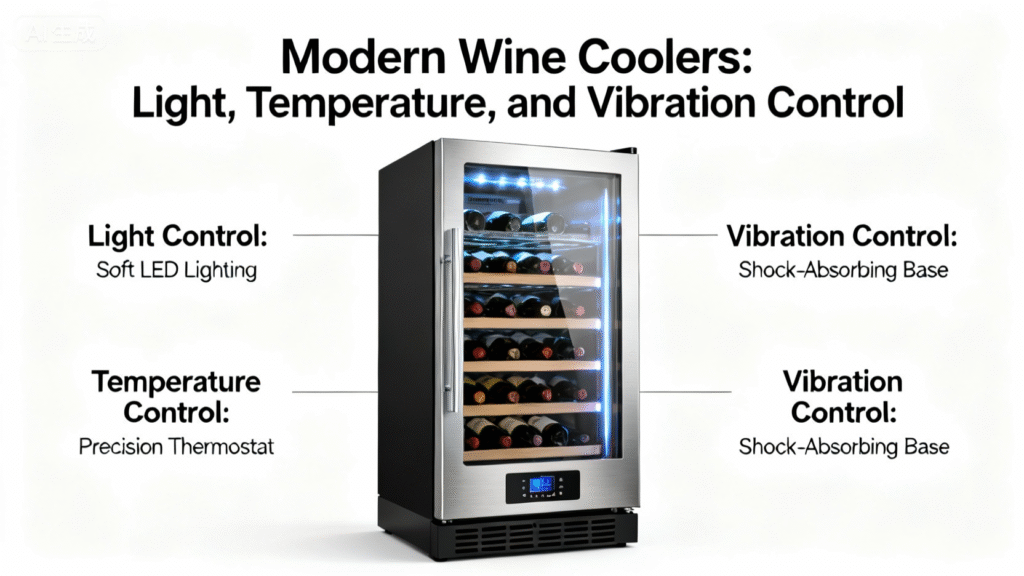
For any wine enthusiast, proper storage is the cornerstone of preserving a collection’s value and taste. This article delves into the essential features of a modern wine cooler, explaining how specific technologies like light protection, precise temperature control, and efficient cooling work in harmony to create the ideal environment for your wine to mature gracefully and maintain its intended character.
The Enemies of Wine: Light and Temperature Fluctuation
Two of the most significant threats to wine are ultraviolet light and inconsistent temperatures. UV rays can degrade and prematurely age wine, a process known as “light strike,” which damages organic compounds and alters the flavor. As one Reddit user in r/wine emphasized, “Keeping your wine in a dark place isn’t just a suggestion; it’s a necessity if you care about its longevity.” Similarly, temperature swings cause the wine to expand and contract, potentially pulling in air through the cork and leading to oxidation. A stable environment is non-negotiable, which is why a dedicated wine cooler is far superior to a standard kitchen refrigerator.
Engineering the Perfect Climate: Cooling and Stabilization
Beyond just being cool, the internal climate must be stable and vibration-free. This is achieved through advanced systems like the internal air cooling mentioned. Such systems gently circulate air to eliminate hot spots, ensuring every bottle, whether in the front or back, is kept at the same perfect temperature. This meticulous stabilization protects the delicate sediments in older wines and prevents the chemical reactions that spoilage causes. As noted in a Quora discussion on wine refrigerator mechanics, the consistency offered by a dedicated unit is its primary advantage over ad-hoc storage solutions, directly preserving the wine’s integrity.
Design for the Connoisseur: Flexibility and Illumination
Functionality must be paired with thoughtful design. Removable wooden shelves are not merely an aesthetic choice; beech wood is naturally anti-vibration and provides a secure grip on bottles, preventing rattling. This flexibility allows you to reconfigure the space for larger Champagne bottles or a mix of sizes. The inclusion of soft blue LED lighting addresses a key concern for collectors: the need to view labels without exposing the wine to harmful light spectra. This design consideration shows a deep understanding of a collector’s practical needs, making a 30-bottle wine cooler both a utility and a display piece.
Why Capacity and Control Matter
A capacity of 30 Bordeaux-style bottles strikes a balance for many enthusiasts, offering ample space without demanding a large footprint. The user-friendly digital control panel is the command center, granting precise management over the 40°F to 65°F range. This is crucial because different wines age best at different temperatures; for instance, a full-bodied red is often stored at the higher end of the spectrum, while a crisp white is kept cooler. This level of control, as echoed by users on wine forums, is what separates a simple cooling box from a true aging appliance, empowering you to actively curate your collection’s development.
In summary, selecting a wine cooler is an investment in the future of your collection. We have explored how critical features work in concert: protective glass and dark interiors shield against light degradation, while advanced air cooling systems combat the silent threat of temperature fluctuation. The practical design, with its customizable wooden shelving and gentle illumination, merges seamless organization with elegant display. Ultimately, a unit like the 15″ Single Zone 30-Bottle Wine Cooler is not just an appliance; it is a dedicated micro-climate. It gives you, the collector, the confidence that each bottle is stored under optimal conditions, allowing the complex flavors and aromas to evolve as the winemaker intended. Whether you are safeguarding a few prized vintages or building a diverse portfolio, this combination of style and scientific preservation ensures your wine is given the utmost care, ready to be enjoyed at its absolute peak.
I never realized how much vibration control mattered for my wine collection until reading this.
\}}
Here are a few options, from short to long:
**Short & Positive:**
Great breakdown of why light, temperature, and vibration control are so crucial for a wine cooler.
**Neutral & Conversational:**
I never realized how much damage light and vibration could do until reading this; the technology in modern wine coolers is fascinating.
**Longer & Positive:**
As a collector, it’s reassuring to see how modern wine coolers are designed to protect your investment from light, temperature swings, and vibration.
\}}
I never realized how much vibration could affect my wine, but this article explains it perfectly.
\}}
I never realized how much vibration could affect my wine, but this article explains it perfectly.
\}}
I never realized how much vibration could affect my wine, but this article makes a compelling case for a modern cooler with that feature.
\}}
I never realized how much vibration could affect my wine, but this article makes a compelling case for a modern cooler with that feature.
\}}
I never realized how much vibration could affect my wine, but this article makes a compelling case for a modern cooler with that feature.
\}}
I never realized how much vibration could affect my wine, but this article makes a compelling case for a modern cooler with that feature.
\}}
I never realized how much vibration control mattered for my wine until I read this.
\}}
I never realized how much vibration control mattered for my wine until I read this.
\}}
I never realized how much vibration control mattered for wine storage until I read this.
\}}
I never realized how much vibration could affect my wine, but this article explains it perfectly.
\}}