
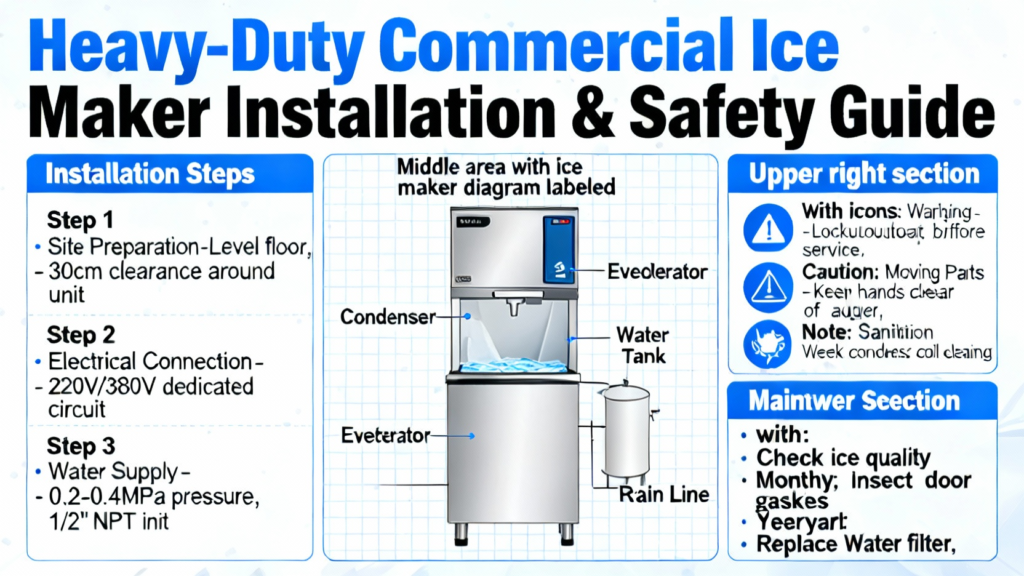
For restaurants, bars, and hotels, a reliable ice maker is the backbone of service. This guide delves into the Heavy-Duty Commercial Ice Maker, exploring its robust stainless steel construction, efficient 110V operation, and critical installation requirements. Understanding these details ensures optimal performance, safety, and longevity for your high-volume ice production needs.
Engineering for Endurance: Build and Environmental Compatibility
At the core of this unit is its durable stainless steel construction, a material chosen for its corrosion resistance, ease of cleaning, and ability to withstand the rigors of a commercial kitchen. This aligns with industry standards where stainless steel is preferred for food contact surfaces due to its non-porous nature. The machine is designed for Climate types SN, N, ST, meaning it is tested to perform reliably in varied ambient temperatures, from subtropical to temperate environments. This broad compatibility is crucial for operations in different geographical locations. The use of environmentally friendly R290 (propane) refrigerant is a forward-thinking feature. As noted in discussions on refrigerant trends, R290 has a very low Global Warming Potential (GWP) compared to traditional HFCs, making it a more sustainable choice, though it requires specific safety considerations during servicing.
Power, Placement, and Prerequisites for Operation
This ice maker operates on a standard 110V/60Hz circuit, drawing 780W, but its installation demands careful planning. As the specifications note, it requires a drinking water supply with a precise pressure of 14.5-58 psi. Pressure outside this range can lead to machine failure, necessitating a changeover valve. Furthermore, a proper gravity drain connection is mandatory, as wastewater and meltwater are continuously expelled. Physical placement is equally critical: a minimum 5.9 inches of clearance on all sides is required for airflow and heat dissipation, preventing overheating and efficiency loss. The unit must be kept from heat sources and direct sunlight, as ambient temperature directly influences ice production cycles.
Critical Safety and Initial Startup Protocols
Adhering to safety guidelines is non-negotiable. The unit features a three-prong plug and a 70-inch cord; using an extension cord is explicitly warned against due to the risk of overheating and fire—a common hazard highlighted in electrical safety forums. The manual also warns against placing the unit near flammable materials or using it outdoors. A vital, often overlooked step is the 24-hour settling period after delivery. This allows the refrigerant and compressor oil, which may have been disturbed during transit, to settle, preventing compressor damage upon startup. This is a standard but crucial procedure for any refrigeration equipment, as emphasized by HVAC professionals on platforms like Reddit.
Optimizing Performance and Long-Term Reliability
To ensure the machine meets its potential, users must follow operational best practices. Only potable water should be used, as other liquids can damage the internal components and contaminate ice. The net weight of 145.51 lbs and dimensions of 26.4 × 23.2 × 61.4 in indicate a substantial piece of equipment that requires a stable, level location. Regular cleaning and maintenance, as per the manufacturer’s instructions, are essential to prevent scale buildup and sanitary issues. Understanding that ice production time varies with room temperature helps set accurate expectations for ice supply during peak hours.
In summary, the Heavy-Duty Commercial Ice Maker is engineered as a resilient workhorse for foodservice, combining durable stainless-steel construction with an eco-friendly R290 refrigerant system. Its successful integration into your operation hinges on meticulous attention to the prerequisites: a dedicated water line with correct pressure, a proper drain, adequate ventilation space, and a standard 110V outlet. The mandatory 24-hour settling period post-delivery and strict adherence to electrical safety, including avoiding extension cords, are critical to safeguarding your investment. By respecting these installation and operational guidelines—from ensuring the drain outlet is lower than the machine to keeping it away from heat sources—you directly contribute to the unit’s reliability, efficiency, and lifespan. For operations requiring robust output, such as the 23.23 in. 750 lbs./24h Capacity Commercial Stainless Steel Ice Maker, these steps are not mere suggestions but foundational requirements for uninterrupted service. Ultimately, this commercial stainless steel ice maker offers the promise of consistent ice production, fulfilling a vital role in the daily rhythm of hospitality and catering businesses when installed and maintained with informed care.
Thanks for this detailed guide; it really highlights how crucial proper installation is for a heavy-duty commercial ice maker to keep things running smoothly.
\}}
Thanks for this detailed guide; it really highlights how crucial proper installation is for a heavy-duty commercial ice maker to keep things running smoothly.
\}}
Thanks for this detailed guide; it really highlights how crucial proper installation is for a heavy-duty commercial ice maker to keep things running smoothly.
\}}
Thanks for this detailed guide; it really highlights how crucial proper installation is for a heavy-duty commercial ice maker to keep things running smoothly.
\}}
This guide really highlights why understanding the installation requirements is so critical for getting the most out of a heavy-duty commercial ice maker.
\}}
This guide really highlights why understanding the installation requirements is so critical for getting the most out of a heavy-duty commercial ice maker.
\}}
This guide really highlights why understanding the installation requirements is so critical for getting the most out of a heavy-duty commercial ice maker.
\}}
This guide really highlights why understanding the installation requirements is so critical for getting the most out of a heavy-duty commercial ice maker.
\}}
This guide really highlights why understanding the installation requirements is so critical for getting the most out of a heavy-duty commercial ice maker.
\}}
This guide really highlights why understanding the installation details is so critical for getting the most out of a heavy-duty commercial ice maker.
\}}
This guide really highlights why understanding the installation details is so critical for getting the most out of a heavy-duty commercial ice maker.
\}}
This guide really highlights why understanding the installation details is so critical for getting the most out of a heavy-duty commercial ice maker.
\}}