
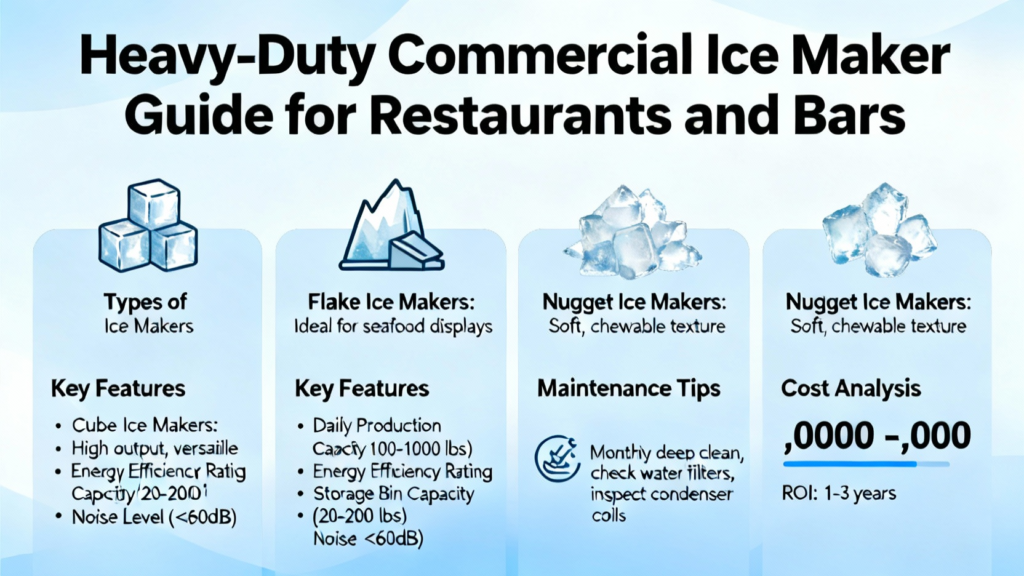
For restaurants, bars, and hotels, a reliable ice maker is the backbone of service. This guide delves into the heavy-duty commercial ice maker, focusing on its durable stainless steel construction, efficient 110V operation, and critical installation requirements. Understanding these details ensures optimal performance, safety, and longevity for your business’s essential equipment.
Engineering for Endurance and Efficiency
Built with durable stainless steel construction, this ice maker is designed to withstand the rigors of a commercial kitchen. Stainless steel is the industry standard for food service equipment due to its corrosion resistance and ease of cleaning, as noted in discussions on commercial equipment longevity. The unit utilizes environmentally friendly R290 refrigerant (propane), a hydrocarbon with a low Global Warming Potential (GWP) that is gaining adoption as a sustainable alternative to traditional HFCs. Operating on standard 110V 60Hz power with a 780W draw, it offers high-capacity ice production without requiring specialized electrical circuits, making it versatile for various locations.
Critical Installation and Site Preparation
Proper installation is paramount. The unit requires a direct connection to a drinking water supply with a pressure between 14.5-58 psi; outside this range, a pressure changeover valve is mandatory to prevent damage. As emphasized in installer forums, a gravity-fed drainage pipe must be connected, with its outlet lower than the machine’s, to handle constant meltwater discharge. The machine needs a minimum of 6 inches of clearance on all sides for airflow, and it must be placed away from heat sources and direct sunlight. A critical, often overlooked step is to let the unit stand upright for 24 hours after delivery before initial use, allowing the refrigerant and oils to settle after transit, which is a standard manufacturer directive for compressor longevity.
Operational Safety and Best Practices
Adhering to safety protocols protects both personnel and equipment. The ice maker comes with a three-prong plug and a 70-inch cord; using an extension cord is strongly discouraged as it can overheat and pose a fire risk, a point frequently highlighted in electrical safety guidelines. The unit must be kept away from flammable materials and is not recommended for outdoor use, as environmental elements and temperature fluctuations can severely impact its components and ice-making cycle time. Only potable water should be used; introducing other liquids can damage the internal system and contaminate ice, violating health codes.
Performance in Varied Environments
This model is rated for climate types SN, N, and ST (Subnormal, Normal, and Subtropical), meaning it’s engineered to perform reliably in a wide range of ambient temperatures. However, the surrounding environmental temperature directly influences ice production speed and efficiency; a hotter kitchen will result in longer cycle times. The robust construction and climate compatibility make it an ideal workhorse for demanding operations like catering, high-volume bars, and hotels, where consistent output is non-negotiable.
In conclusion, selecting and operating a heavy-duty commercial ice maker is a significant investment that demands careful attention to detail. From its stainless steel durability and eco-friendly R290 refrigerant to the non-negotiable installation requirements like proper water pressure, drainage, and electrical safety, each factor plays a crucial role in the machine’s performance and lifespan. The operational guidelines—such as allowing the 24-hour settling period, avoiding extension cords, and ensuring adequate clearance—are not mere suggestions but essential practices rooted in equipment engineering and safety standards. By thoroughly understanding and implementing these principles, business owners and operators can ensure their ice maker delivers reliable, hygienic, and efficient service day in and day out, supporting the seamless operation of their food service or hospitality establishment and safeguarding their investment for years to come.
This guide really highlights how a reliable heavy-duty commercial ice maker is essential for keeping service smooth in busy restaurants and bars.
\}}
This guide really highlights how a reliable heavy-duty commercial ice maker is essential for keeping service smooth in busy restaurants and bars.
\}}
This guide really highlights how a reliable heavy-duty commercial ice maker is essential for keeping service smooth in busy restaurants and bars.
\}}
This guide really highlights how a reliable heavy-duty commercial ice maker is essential for keeping service smooth in busy restaurants and bars.
\}}
This guide really highlights how a reliable heavy-duty commercial ice maker is essential for keeping service smooth in busy restaurants and bars.
\}}
This guide really highlights how a heavy-duty commercial ice maker is essential for keeping service smooth in busy restaurants and bars.
\}}
This guide really highlights how a heavy-duty commercial ice maker is essential for keeping service smooth in busy restaurants and bars.
\}}
This guide really highlights how a heavy-duty commercial ice maker is essential for keeping service smooth in busy restaurants and bars.
\}}
This guide really highlights how a heavy-duty commercial ice maker is essential for keeping service smooth in busy restaurants and bars.
\}}
This guide really highlights why a reliable heavy-duty commercial ice maker is such a game-changer for busy service environments.
\}}
This guide really highlights why a reliable heavy-duty commercial ice maker is such a game-changer for busy service environments.
\}}