
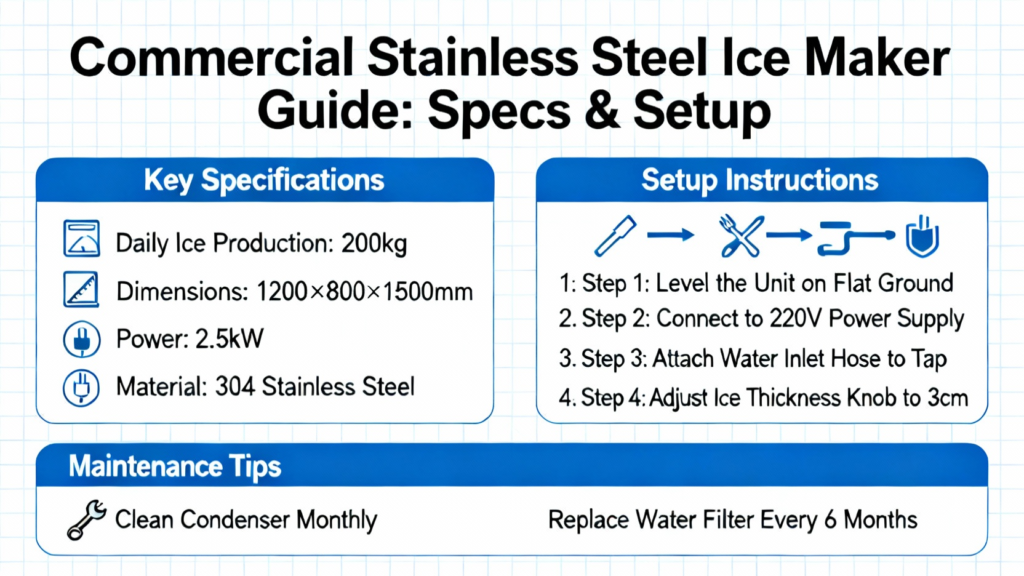
Selecting the right commercial ice maker is a critical decision for any foodservice business. This guide delves into the key specifications, installation requirements, and operational best practices for a robust stainless steel ice machine, ensuring you maximize reliability, efficiency, and safety in your restaurant, bar, or hotel.
Engineering for Commercial Durability and Performance
At the core of this unit is its heavy-duty stainless steel construction, a material chosen for its exceptional resistance to corrosion, ease of cleaning, and longevity in high-demand environments. The use of environmentally friendly R290 (propane) refrigerant is a forward-thinking choice. As noted in discussions on refrigerant phases, R290 has a significantly lower Global Warming Potential (GWP) than traditional HFCs, aligning with global environmental regulations like the EPA’s SNAP program. Its compatibility with climate types SN, N, and ST (Subnormal, Normal, and Subtropical) ensures reliable performance across a wide range of ambient temperatures, a crucial factor for kitchens with variable conditions.
With a net weight of approximately 145.51 lb and dimensions of 26.4″ x 23.2″ x 61.4″, this is a substantial piece of equipment designed for stationary, high-output use. Its 780W power draw on a standard 110V/60Hz circuit makes it accessible for most commercial settings without requiring specialized electrical upgrades. For businesses seeking a model with these durable specs, the 23.2 in. 500 lbs./24h Capacity Commercial Stainless Steel Ice Maker represents a prime example of this design philosophy.
Critical Installation and Setup Protocols
Proper installation is non-negotiable for performance and safety. The machine requires a potable drinking water supply with a pressure between 14.5-58 psi. Pressure outside this range can lead to system failure and requires a changeover valve. Equally important is the gravity-fed drainage system; the drain pipe outlet must be lower than the machine’s port to allow meltwater and wastewater to flow freely, preventing internal flooding and sanitation issues.
Ventilation is key to operational efficiency. Maintaining at least 5.9 inches (15 cm) of clearance on all sides allows for adequate airflow around the condenser, preventing overheating and excessive energy consumption. Furthermore, the unit must be placed away from direct sunlight, stoves, or radiators, as ambient heat directly impacts ice production time and compressor strain. As highlighted in a Reddit discussion from November 2023, proper spacing and ambient temperature control are among the most common oversights leading to premature equipment failure.
Essential Safety and Operational Guidelines
Adhering to safety guidelines protects both your staff and your investment. The unit comes with a three-prong plug and a 70-inch cord; using an extension cord is strongly discouraged as it can overheat and create a fire hazard, especially with a 780W load. The machine must also be kept away from flammable materials. For initial setup, a critical step is to let the unit stand upright for 24 hours after delivery before plugging it in. This allows the compressor oil, which may have been displaced during transit, to settle, preventing severe damage upon startup—a point often emphasized in appliance manuals and technician forums.
Operational rules are straightforward but vital: use only water to make ice, never other liquids, and understand that the ice-making cycle time is influenced by the surrounding environmental temperature. In hotter environments, the unit will work harder and may produce ice less frequently. Regular cleaning and maintenance, as per the manufacturer’s schedule, are also essential to prevent scale buildup and ensure food-safe ice production.
Conclusion: A Foundation for Reliable Service
Investing in a commercial ice maker like the stainless steel ice maker is an investment in the seamless operation of your business. This analysis underscores that its durable construction and environmentally conscious R290 refrigerant are matched by a set of precise installation and operational requirements. From ensuring correct water pressure and drainage to guaranteeing proper ventilation and adhering to critical safety protocols like avoiding extension cords and allowing proper settling time, each guideline serves a direct purpose in ensuring longevity and peak performance.
Ignoring these factors can lead to reduced efficiency, higher energy costs, frequent breakdowns, and even safety hazards. By treating the ice maker as a core piece of commercial equipment that requires specific conditions to thrive—much like a high-performance oven or refrigeration system—you secure a reliable supply of ice, which is the lifeblood of beverage service and food presentation. Ultimately, understanding and implementing these detailed specifications transforms a simple appliance into a dependable asset, supporting your business’s daily operations and contributing to a professional, efficient, and safe kitchen environment for years to come.
This guide really helped clarify the key specs for choosing a reliable stainless steel ice maker for our new setup.
\}}
This guide really helped clarify the key specs for choosing a reliable stainless steel ice maker for our new setup.
\}}
This guide really helped clarify the key specs for choosing a reliable stainless steel ice maker for our new setup.
\}}
This guide really helped clarify the key specs for choosing a reliable stainless steel ice maker for our new setup.
\}}
This guide really helped clarify the key specs for choosing a reliable stainless steel ice maker for our new setup.
\}}
This guide really helped me understand the key specs for choosing a reliable stainless steel ice maker for my restaurant.
\}}
This guide really helped me understand the key specs for choosing a reliable stainless steel ice maker for my restaurant.
\}}
This guide really helped me understand the key specs for choosing a reliable stainless steel ice maker for my restaurant.
\}}
This guide really helped me understand the key specs for choosing a reliable stainless steel ice maker for my restaurant.
\}}
This guide really helped me understand the key specifications for choosing a reliable stainless steel ice maker for our restaurant.
\}}
This guide really helped me understand the key specifications for choosing a reliable stainless steel ice maker for our restaurant.
\}}