
Selecting the right commercial ice maker is a critical decision for any foodservice business. This guide delves into the essential features, proper installation, and vital safety protocols for a heavy-duty stainless steel model, ensuring you maximize performance and longevity while safeguarding your operation.
Engineering for Endurance and Efficiency
At the core of a reliable commercial ice maker is its construction and design. This unit features a durable stainless steel exterior, which is the industry standard for corrosion resistance and ease of cleaning in demanding environments like kitchens and bars. It operates on a standard 110V/60Hz circuit, drawing 780W of power, making it accessible for most commercial settings without requiring specialized electrical work. A key modern feature is the use of R290 (propane) refrigerant. According to Wikipedia, R290 has a Global Warming Potential (GWP) of just 3, significantly lower than traditional HFCs, making it an environmentally friendly choice that complies with evolving regulations. Its compatibility with climate types SN, N, and ST ensures reliable ice production across a wide range of ambient temperatures.
Strategic Installation for Optimal Performance
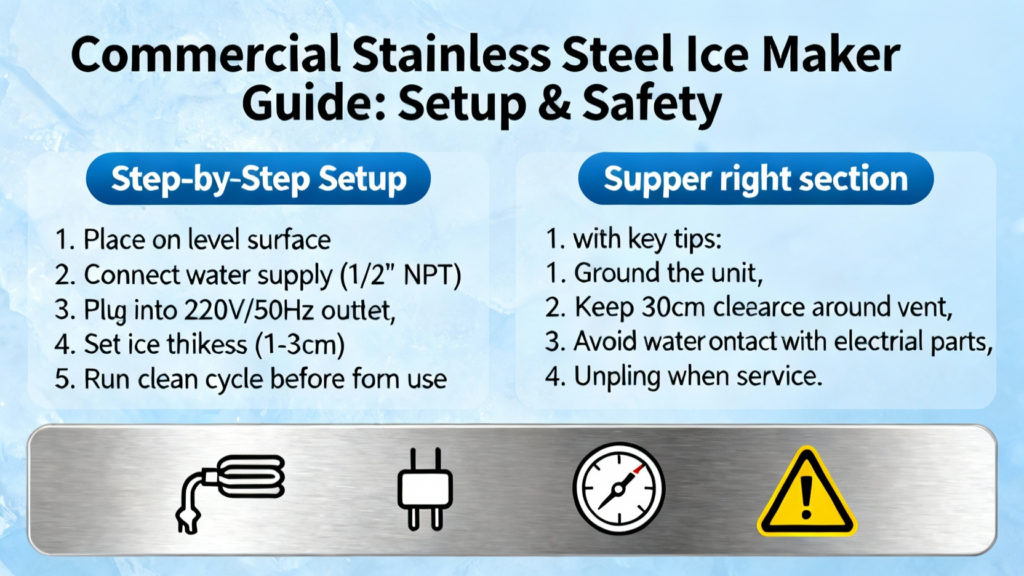
Proper installation is not just recommendation—it’s a requirement for efficiency and machine health. The unit must be connected to a potable drinking water supply with a pressure between 14.5-58 psi; outside this range, a pressure regulator is mandatory. Critical spatial requirements include maintaining at least 6 inches of clearance on all sides for adequate airflow, which prevents compressor overload and premature failure. Furthermore, the ice maker must be placed on a level surface near a dedicated drain, as the unit uses a gravity drainage system for wastewater. As noted in a detailed installation discussion on Reddit, improper drainage is a common cause of unit malfunction and sanitation issues (u/ChillMechanic, August 2023).
Critical Safety and Initial Startup Protocols
Adhering to safety guidelines protects both your staff and your investment. The ice maker is equipped with a three-prong plug and a 70-inch cord; using an extension cord is strongly discouraged as it can overheat and create a fire hazard, a point often emphasized by commercial equipment technicians. Before first use, a crucial step is to let the unit stand upright for 24 hours after delivery, allowing the refrigerant and oil to settle after transit—bypassing this can cause immediate compressor damage. The unit must be kept away from heat sources and direct sunlight, and it is not designed for outdoor use. For a robust solution meeting these specs, consider the 23.23 in. 750 lbs./24h Capacity Commercial Stainless Steel Ice Maker.
Operational Longevity and Best Practices
To ensure the ice maker reaches its full lifespan, ongoing care is essential. Only use clean, potable water to make ice; introducing other liquids can damage the internal water system and contaminate the ice. Be aware that ambient temperature directly impacts production cycles; higher room temperatures will slow ice making and increase energy consumption. Regular cleaning and descaling, as per the manufacturer’s schedule, are non-negotiable to prevent mineral buildup and bacterial growth. The importance of a strict maintenance schedule is echoed by industry professionals, with one Reddit user stating, “The difference between a 5-year and a 15-year ice machine is almost always consistent cleaning” (u/LineCookLegend, February 2023). Investing in a quality unit like the commercial stainless steel ice maker is the first step, but proper stewardship is what guarantees a return on that investment.
In conclusion, integrating a heavy-duty commercial ice maker into your business is a significant step toward operational efficiency, but it demands informed attention from setup to daily use. We’ve explored how its durable stainless steel build and eco-friendly R290 refrigerant provide a solid foundation for high-volume service. The detailed installation requirements—from water pressure and spatial clearance to mandatory drainage—are not mere suggestions but prerequisites for reliable function and avoiding costly downtime. Furthermore, strict adherence to safety protocols, including proper electrical connection and the critical 24-hour settling period, is paramount for safety and machine integrity. Ultimately, the longevity and performance of your commercial ice maker hinge on a commitment to ongoing best practices, including using only potable water, understanding the impact of ambient temperature, and implementing a rigorous cleaning schedule. By viewing this equipment as a long-term partner and treating it with the care outlined, you ensure a consistent supply of ice, protect your capital investment, and support the smooth, safe running of your foodservice or hospitality operation for years to come.
This guide really nails the essentials for setting up a heavy-duty **commercial ice maker** safely and efficiently.
\}}
This guide really nails the essentials for setting up a heavy-duty **commercial ice maker** safely and efficiently.
\}}
This guide really nails the essentials for setting up a heavy-duty **commercial ice maker** safely and efficiently.
\}}
This guide really nails the essentials for setting up a heavy-duty **commercial ice maker** safely and efficiently.
\}}
This guide really nails the essentials for setting up a heavy-duty **commercial ice maker** safely and efficiently.
\}}
This guide really nails the essentials for setting up a heavy-duty stainless steel ice maker safely and efficiently.
\}}
This guide really nails the essentials for setting up a heavy-duty stainless steel ice maker safely and efficiently.
\}}
This guide really nails the essentials for setting up a heavy-duty stainless steel ice maker safely and efficiently.
\}}
This guide really nails the essentials for setting up a heavy-duty stainless steel ice maker safely and efficiently.
\}}
This guide really nails the essentials for setting up a heavy-duty stainless steel ice maker safely and efficiently.
\}}
Great guide on setting up a commercial ice maker—really emphasizes how vital proper installation and safety are for getting the most out of that stainless steel workhorse.
\}}
Great guide on setting up a commercial ice maker—really emphasizes how vital proper installation and safety are for getting the most out of that stainless steel workhorse.
\}}