
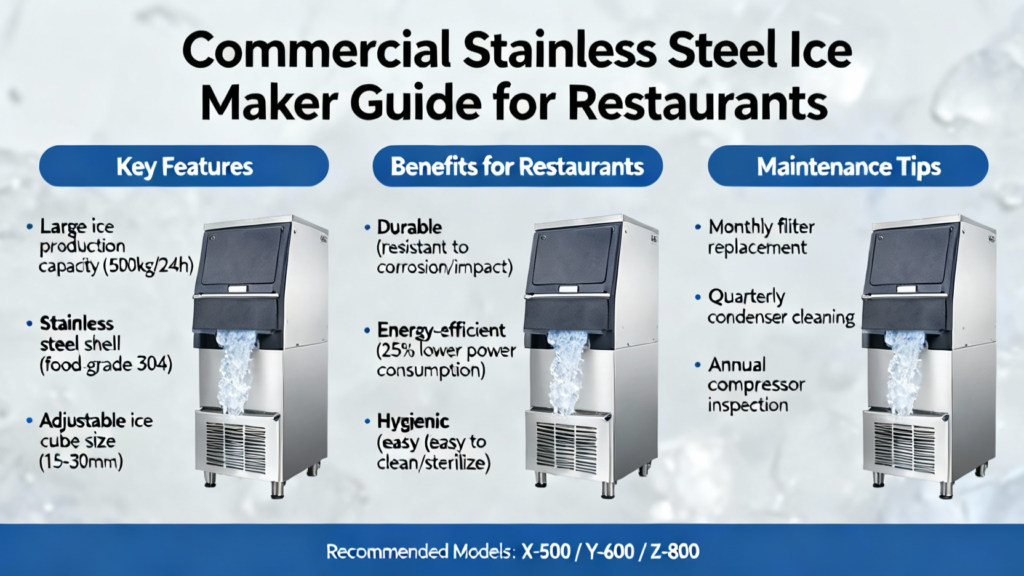
For restaurants, bars, and hotels, a reliable ice maker is a cornerstone of daily operations. This guide delves into the critical specifications and installation requirements of a heavy-duty, stainless steel commercial ice maker. We’ll explore its durable construction, optimal setup for safety and performance, and essential maintenance insights to ensure your business never runs out of ice.
Engineering for Endurance: Stainless Steel and Eco-Conscious Design
The defining feature of this unit is its durable stainless steel construction, a material chosen for its resistance to corrosion, ease of cleaning, and ability to withstand the rigors of a commercial kitchen. Stainless steel’s durability is well-documented, with its alloy composition providing a protective layer that prevents rust. Furthermore, this ice maker utilizes environmentally friendly R290 refrigerant. R290, or propane, is a natural refrigerant with a very low Global Warming Potential (GWP), making it a responsible choice as industries move away from synthetic hydrofluorocarbons (HFCs). Its efficiency is a key benefit for a machine designed for continuous operation.
Power, Placement, and Prerequisites for Installation
Proper installation is non-negotiable for performance and safety. This model operates on standard 110V 60Hz power, drawing 780W. It requires a dedicated drinking water supply with a pressure between 14.5-58 psi. Crucially, as noted in the manual, a drainage pipe must be connected with its outlet lower than the machine’s to allow meltwater to discharge by gravity. Physical placement requires at least 5.9 inches of clearance on all sides for adequate airflow, which is essential for the condenser to release heat efficiently. This aligns with general appliance installation advice found on forums like r/KitchenConfidential, where professionals emphasize airflow to prevent overheating and premature failure.
Critical Safety and Initial Startup Protocols
Adhering to safety guidelines protects your investment and your premises. The ice maker comes with a three-prong plug and a 70-inch cord; using an extension cord is strongly discouraged as it can overheat. It must be kept away from flammable materials and heat sources like stoves. A vital, often overlooked step is the 24-hour settling period after delivery. If the unit has been tilted during transport, the compressor oil needs time to flow back to its proper place. Plugging it in immediately can cause severe compressor damage, a point frequently stressed by HVAC technicians on Reddit threads discussing appliance handling. For a model built for high-volume output like the 23.2 in. 500 lbs./24h Capacity Commercial Stainless Steel Ice Maker, protecting the compressor from such avoidable damage is paramount.
Optimizing Performance in Your Commercial Environment
This ice maker is designed for Climate types SN, N, ST, meaning it can perform reliably in varied temperate environments. However, its ice production time is influenced by the ambient room temperature; a hotter kitchen will naturally reduce efficiency. It is not recommended for outdoor use, as direct sunlight and extreme temperature swings would strain the system. For consistent results, use only potable water, as sugars or minerals in other liquids can damage the internal components and affect ice quality. Regular cleaning, as per the manufacturer’s schedule, is the final key to longevity. The importance of a strict maintenance routine for commercial ice makers is a universal recommendation, underscored by resources like Wikipedia’s entry on ice machines, which notes that scale buildup from water minerals is a primary cause of malfunction.
In summary, integrating a heavy-duty commercial ice maker into your business is an investment in operational fluidity. Its stainless steel build and R290 refrigerant speak to a design focused on durability and environmental responsibility. Success, however, hinges on meticulous installation—ensuring proper water pressure, essential clearance for ventilation, and correct drainage. Rigorous adherence to safety, especially the critical 24-hour settling period and avoiding extension cords, safeguards the equipment from preventable harm. Finally, understanding that factors like ambient temperature will affect output allows for realistic planning. By following these guidelines, you ensure that a workhorse appliance like the 500 lbs./24h Capacity Commercial Stainless Steel Ice Maker delivers its promised reliability, keeping your service seamless and your customers satisfied with every chilled beverage. Proper care transforms this machine from a simple appliance into a dependable pillar of your daily service.
Great guide—knowing the right specs for a stainless steel commercial ice maker can really save a restaurant from daily headaches.
\}}
Great guide—knowing the right specs for a stainless steel commercial ice maker can really save a restaurant from daily headaches.
\}}
Great guide—knowing the right specs for a stainless steel commercial ice maker can really save a restaurant from daily headaches.
\}}
Great guide—knowing the right specs for a stainless steel commercial ice maker can really save a restaurant from daily headaches.
\}}
This guide really highlights why a durable stainless steel commercial ice maker is such a smart investment for busy kitchens.
\}}
This guide really highlights why a durable stainless steel commercial ice maker is such a smart investment for busy kitchens.
\}}
This guide really highlights why a durable stainless steel commercial ice maker is such a smart investment for busy kitchens.
\}}
This guide really highlights why a durable stainless steel ice maker is such a smart investment for busy restaurant kitchens.
\}}
This guide really highlights why a durable stainless steel ice maker is such a smart investment for busy restaurant kitchens.
\}}
This guide really highlights why a durable stainless steel ice maker is such a smart investment for busy restaurant kitchens.
\}}