
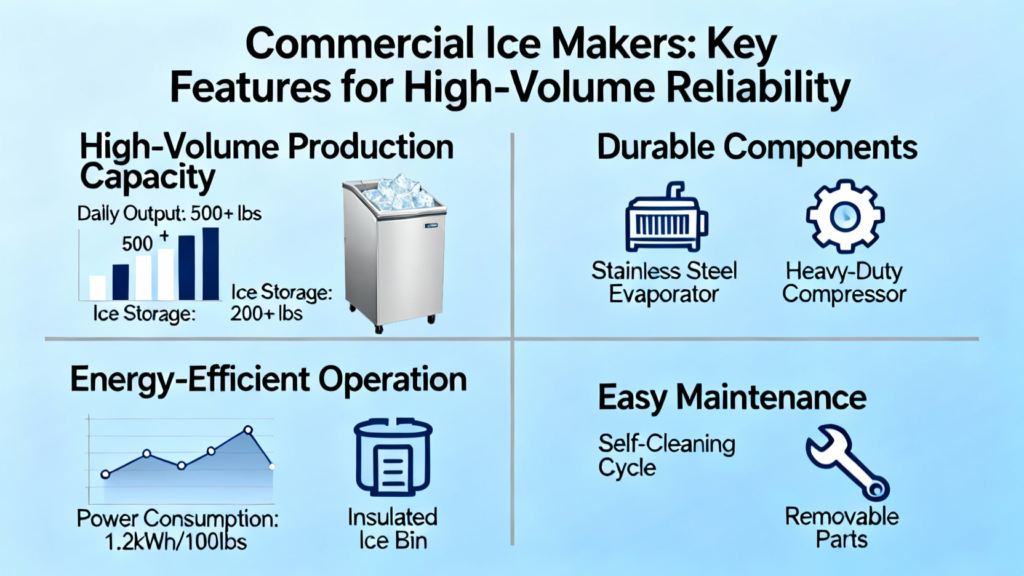
In today’s demanding commercial environments, from bustling bars to high-volume restaurants, a reliable ice supply is non-negotiable. This article explores the critical features that define a superior commercial ice maker, using the high-capacity 182 Modular Ice Maker as a benchmark. We will delve into the engineering behind consistent production, the importance of smart storage and hygiene, and the operational innovations that ensure seamless integration into your daily service, ultimately safeguarding your business’s reputation and efficiency.
Engineering for Uninterrupted High-Volume Production
At the core of any commercial ice maker is its ability to meet peak demand without faltering. A unit like the 22.24 in. 600 lbs./24h Ice Tray Count 182 Stainless Steel Split Commercial Ice Maker is engineered for this exact purpose. The split-system design, where the condenser is separate from the ice-making head, is crucial. This architecture, as noted in discussions on commercial kitchen efficiency, allows the unit to be installed in tighter spaces with better ventilation, preventing overheating and maintaining optimal performance during continuous cycles. The powerful compressor and fan system work in tandem to achieve the advertised 600-pound daily output, a figure that must be understood as a maximum under ideal conditions (approximately 40°F ambient air and 70°F water temperature). Real-world output can vary, but robust engineering minimizes this variance.
Storage, Hygiene, and Ice Quality Preservation
Producing ice is only half the battle; preserving its quality and hygiene is equally critical. A generous 300-pound storage bin prevents the ice from being crushed under its own weight, maintaining the structural integrity of the full-size cubes. The inclusion of an advanced filtration system is a non-negotiable feature for both ice clarity and taste. As highlighted on Wikipedia’s page on water filtration, sediment and carbon filters remove particulates and chlorine, directly impacting the final product’s purity. Furthermore, commercial health code discussions on forums like r/Chefit consistently stress the importance of clean ice as a food safety issue. Features like a built-in, dedicated ice scoop and a sanitary storage environment are essential for compliance and customer safety.
Operational Intelligence and User-Centric Design
Modern commercial equipment must simplify operations, not complicate them. The user-friendly touch control panel represents a significant leap from manual dials, offering precise control over cycles and diagnostics. This digital interface allows for quick adjustments and can signal maintenance needs, reducing downtime. In a Reddit thread from April 2023 on bar equipment maintenance, users emphasized that easy-to-understand controls and reliable alert systems are key to preventing costly failures. The modular and freestanding design of this ice maker category offers flexibility in installation and serviceability, allowing front-of-house staff to focus on service rather than machine troubleshooting.
The Bottom Line: Reliability as a Business Investment
Choosing a commercial ice maker is a strategic investment in business continuity. The true cost isn’t just the purchase price, but the cost of downtime—lost sales, compromised service, and potential health code violations. A machine built with a stainless steel exterior, a reliable compressor, and a thoughtful design like the 182 Split Commercial Ice Maker is engineered to mitigate these risks. It transforms ice from a simple commodity into a dependable pillar of your daily operation.
In conclusion, selecting a commercial ice maker requires a holistic look beyond mere production numbers. As we’ve explored, the 182 Modular Ice Maker exemplifies the synergy needed for success: robust engineering for high-volume, consistent output; intelligent storage and filtration to ensure purity and compliance with health standards, a point rigorously debated by industry professionals online; and user-centric operational design that empowers staff and minimizes operational friction. This combination ensures that your business is equipped not just with an appliance, but with a reliable system that supports peak service performance. When your ice supply is guaranteed, you protect revenue streams during rushes and uphold the quality perception that keeps customers returning. Ultimately, in the hospitality and food service sectors, dependability is the cornerstone of reputation. Investing in a capable, well-designed ice production system is, therefore, a direct investment in your business’s resilience and customer satisfaction. Elevate your service foundation by ensuring that the essential element of fresh, clean ice is always flowing.
The 182 Modular Ice Maker sounds like it really sets the benchmark for high-volume reliability that busy kitchens need.
\}}
The 182 Modular Ice Maker sounds like it really sets the benchmark for high-volume reliability that busy kitchens need.
\}}
The 182 Modular Ice Maker sounds like it really sets the benchmark for high-volume reliability that busy kitchens need.
\}}
The 182 Modular Ice Maker sounds like it really sets the benchmark for high-volume reliability that busy kitchens need.
\}}
The 182 Modular Ice Maker sounds like it really sets the benchmark for high-volume reliability that busy kitchens need.
\}}
The 182 Modular Ice Maker seems like a perfect example of the high-capacity reliability this article highlights for busy kitchens.
\}}
The 182 Modular Ice Maker seems like a perfect example of the high-capacity reliability this article highlights for busy kitchens.
\}}
The 182 Modular Ice Maker seems like a perfect example of the high-capacity reliability this article highlights for busy kitchens.
\}}