
Unlocking Commercial Ice Production: A Deep Dive into High-Efficiency Ice Makers
For bars, cafes, and restaurants, a reliable ice machine is the unsung hero of operations. This article explores the critical features of modern commercial ice makers, focusing on efficiency, hygiene, and design. We’ll examine how innovations like integrated water filtration and smart automation meet the rigorous demands of food service, ensuring consistent, high-quality ice production.
The Critical Role of Water Filtration in Ice Quality
Superior ice begins with superior water. A high-efficiency water filter is not an accessory but a necessity for any commercial ice maker. It directly impacts taste, clarity, and equipment longevity. Tap water contains minerals like calcium and chlorine, which can affect ice taste and cause scale buildup in the machine’s components. As noted in discussions on water quality, impurities in water are a common concern for appliance performance. The filtration system in a unit like the TITTLA commercial ice maker works to convert tap water into purified water, ensuring each ice cube is clean and odor-free, which is paramount for beverage integrity.
Engineered for Demanding Environments: Durability & Capacity
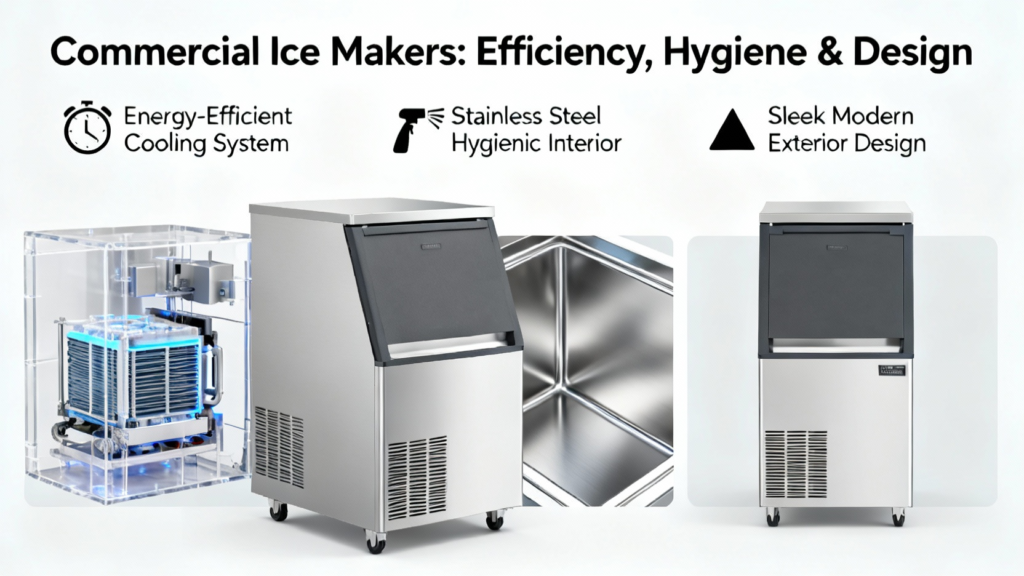
Commercial equipment must withstand constant use. A stainless steel construction is the industry standard, prized for its durability, corrosion resistance, and ease of cleaning. This material choice aligns with food safety guidelines, as its non-porous surface inhibits bacterial growth. Capacity is equally vital. With a production rate of 100 lbs in 24 hours and storage for 24 lbs, such a machine is designed for high-volume scenarios. The use of a powerful 495W compressor, a technology central to refrigeration, enables rapid cycle times—producing 45 cubes in 12-15 minutes—to keep pace with peak service hours without compromise.
Intelligent Operation and Hygienic Maintenance
Modern ice makers integrate smart controls to simplify operation and uphold hygiene. An LCD control panel with programmable settings allows precise management of ice thickness and production cycles. The auto-clean function is a critical feature, addressing a common pain point in maintenance by automating descaling and sanitization, which helps prevent microbial contamination. Furthermore, removable water channels and included tools like drain pipes allow for thorough manual cleaning. As emphasized in food service forums, regular cleaning is non-negotiable for ice safety, making these user-centric features essential for any commercial setting.
Design Considerations for Versatile Commercial Application
The ultimate test of a commercial ice maker is its seamless integration into diverse workflows. Features like a curved observation window with interior lighting enable at-a-glance inventory checks. The freestanding or built-in installation flexibility allows it to fit various kitchen layouts. Practical inclusions, such as a dedicated ice scoop and elevated feet to protect from floor moisture, demonstrate thoughtful design. This versatility makes a stainless steel ice maker a viable solution for locations from coffee shops to canteens, ensuring it meets specific operational needs.
Conclusion: The Pillars of an Optimal Ice Making Solution
In summary, selecting a commercial ice maker requires a focus on several interconnected pillars that directly impact operational success. First, water purification is foundational, ensuring the ice itself is a clean ingredient that won’t alter beverage flavors. Second, robust construction and high capacity, anchored by a reliable compressor and stainless-steel build, guarantee the machine can endure the rigors of daily service while meeting volume demands. Third, intelligent automation and easy maintenance features, like self-cleaning cycles and removable components, are crucial for upholding health standards and reducing labor time. Finally, adaptable design with user-centric details ensures the equipment fits physically and functionally into a fast-paced commercial environment. A unit that synthesizes these elements, such as the TITTLA 100Lbs/24H Commercial Ice Maker, offers more than just ice; it provides reliability, safety, and efficiency. For any business where ice is a constant necessity, investing in a machine that excels in these core areas is an investment in consistent service quality and operational peace of mind.
This deep dive really highlights how a high-efficiency ice maker is the true unsung hero for keeping a busy bar or restaurant running smoothly.
\}}
This deep dive really highlights how a high-efficiency ice maker is the true unsung hero for keeping a busy bar or restaurant running smoothly.
\}}
This deep dive really highlights how a high-efficiency ice maker is the true unsung hero for keeping a busy bar or restaurant running smoothly.
\}}
This deep dive really highlights how a high-efficiency ice maker is the true unsung hero for keeping a busy bar or restaurant running smoothly.
\}}
This deep dive really highlights how a high-efficiency ice maker is the true unsung hero for keeping a busy bar or restaurant running smoothly.
\}}
Great deep dive into how modern efficiency and smart design make these machines the true unsung heroes of a busy kitchen.
\}}
Great deep dive into how modern efficiency and smart design make these machines the true unsung heroes of a busy kitchen.
\}}
Great deep dive into how modern efficiency and smart design make these machines the true unsung heroes of a busy kitchen.
\}}
This deep dive into high-efficiency ice makers really highlights how crucial the right machine is for keeping a busy bar or restaurant running smoothly.
\}}
This deep dive into high-efficiency ice makers really highlights how crucial the right machine is for keeping a busy bar or restaurant running smoothly.
\}}