
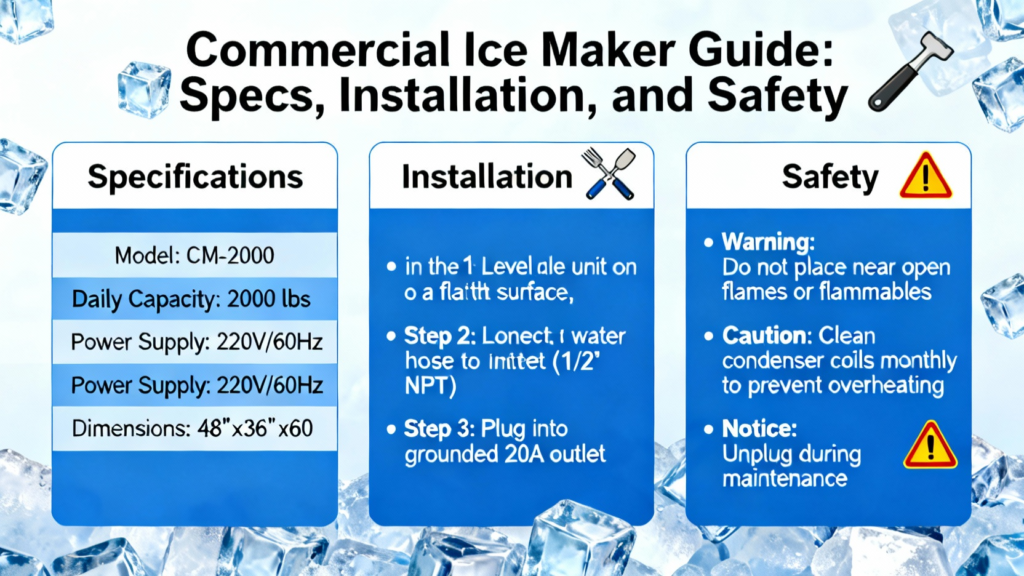
For any bustling foodservice operation, a reliable ice maker is the unsung hero of the back-of-house. This guide delves into the critical specifications, installation requirements, and operational best practices for a heavy-duty commercial ice maker, ensuring you maximize its performance, longevity, and safety in your restaurant, bar, or hotel.
Engineering and Core Specifications for Demanding Environments
This unit is built for endurance with a fully stainless steel construction, a standard in commercial kitchens for its corrosion resistance and ease of cleaning. Operating on a standard 110V/60Hz circuit with 780W power draw, it’s designed for accessibility in most commercial settings. A key feature is its use of R290 (propane) refrigerant, an environmentally friendly option with a low Global Warming Potential (GWP). As noted on Wikipedia, hydrocarbons like R290 are gaining favor as sustainable alternatives to traditional HFCs, though they require specific safety considerations due to flammability, which this unit’s Safety Protection Type I classification addresses. Its compatibility with climate types SN, N, and ST (Subnormal, Normal, and Subtropical) ensures reliable ice production across a wide range of ambient temperatures.
Critical Installation and Setup Procedures
Proper installation is non-negotiable for performance and safety. The unit requires a direct connection to a drinking water supply with a precise pressure of 14.5-58 psi; outside this range, a pressure changeover valve is mandatory. As discussed by users in commercial kitchen subreddits, improper water pressure is a leading cause of machine failure. Ventilation is crucial: maintain at least 6 inches of clearance on all sides. The unit comes with a 70-inch three-prong plug; using an extension cord is strongly discouraged due to fire risk, a point frequently emphasized in industry discussions on electrical safety. Upon delivery, you must let the unit stand upright for 24 hours to let the oils in the compressor settle, a standard procedure for shipped refrigeration equipment.
Operational Safety and Maintenance Best Practices
Safe operation extends beyond installation. The unit must be kept away from flammable materials, direct sunlight, and heat sources like stoves. It is designed for indoor use only. Only use potable water to make ice; other liquids can damage the system and create unsafe ice. A critical and often overlooked step is connecting the gravity drain pipe before first use, as meltwater from the internal bin must be efficiently discharged. The drain outlet must be lower than the machine’s port. Regular cleaning and descaling, as per the manual, are essential to prevent mineral buildup and maintain ice quality and production speed, which can be influenced by the surrounding ambient temperature.
Conclusion: Investing in Reliable Ice Production
Selecting and implementing a commercial ice maker like this stainless steel ice maker requires careful attention to its engineering specs, installation environment, and ongoing care. From its durable stainless steel build and eco-friendly R290 refrigerant to the non-negotiable requirements for proper water pressure, ventilation, and drainage, each factor plays a vital role in ensuring the machine meets its promised capacity and lifespan. Adhering to the safety protocols—such as avoiding extension cords, allowing proper settling time, and ensuring correct placement—protects both your staff and your investment. By understanding that ice production time can vary with ambient conditions and that consistent maintenance is key, operators can ensure this heavy-duty ice maker becomes a dependable cornerstone of daily service. Ultimately, a well-installed and properly maintained unit is not just an appliance; it’s a critical component in the seamless flow of service, supporting everything from beverage service to food presentation in your high-volume establishment.
This guide is a lifesaver for understanding the specs and installation of a commercial ice maker before you buy.
\}}
This guide is a lifesaver for understanding the specs and installation of a commercial ice maker before you buy.
\}}
This guide is a lifesaver for understanding the specs and installation of a commercial ice maker before you buy.
\}}
This guide is a lifesaver for understanding the specs and installation of a commercial ice maker before you buy.
\}}
This guide is a lifesaver for understanding the specs and installation of a commercial ice maker before you buy.
\}}
This guide is a lifesaver for understanding the specs and safety of a commercial ice maker before you buy.
\}}
This guide is a lifesaver for understanding the specs and safety of a commercial ice maker before you buy.
\}}
This guide is a lifesaver for understanding the specs and safety of a commercial ice maker before you buy.
\}}
This guide is a lifesaver for understanding the specs and installation of a commercial ice maker before you buy.
\}}
This guide is a lifesaver for understanding the specs and installation of a commercial ice maker before you buy.
\}}
This guide is a lifesaver for understanding the specs and installation of a commercial ice maker before you buy.
\}}