
For restaurants, bars, and hotels, a reliable ice maker is the backbone of service. This guide delves into the heavy-duty commercial ice maker, focusing on its durable stainless steel construction, efficient 110V operation, and critical installation requirements. We’ll explore its technical specifications, proper setup for safety and performance, and essential maintenance tips to ensure your investment delivers for years to come.
Engineering for Endurance and Efficiency
Built with a durable stainless steel construction, this ice maker is designed to withstand the rigors of a commercial kitchen. Its compatibility with climate types SN, N, and ST ensures reliable performance in varied environments, from steady temperate zones to subtropical regions. The unit operates on a standard 110V/60Hz circuit, drawing 780W of power, and utilizes environmentally friendly R290 (propane) refrigerant. R290 is recognized for its low global warming potential, a fact noted on Wikipedia’s entry for R-290, making it a more sustainable choice. With a net weight of approximately 145.51 lb and dimensions of 26.4″ x 23.2″ x 61.4″, its robust design is engineered for high-volume output in demanding settings like the 23.2 in. 500 lbs./24h Capacity Commercial Stainless Steel Ice Maker.
Critical Pre-Installation and Safety Protocols
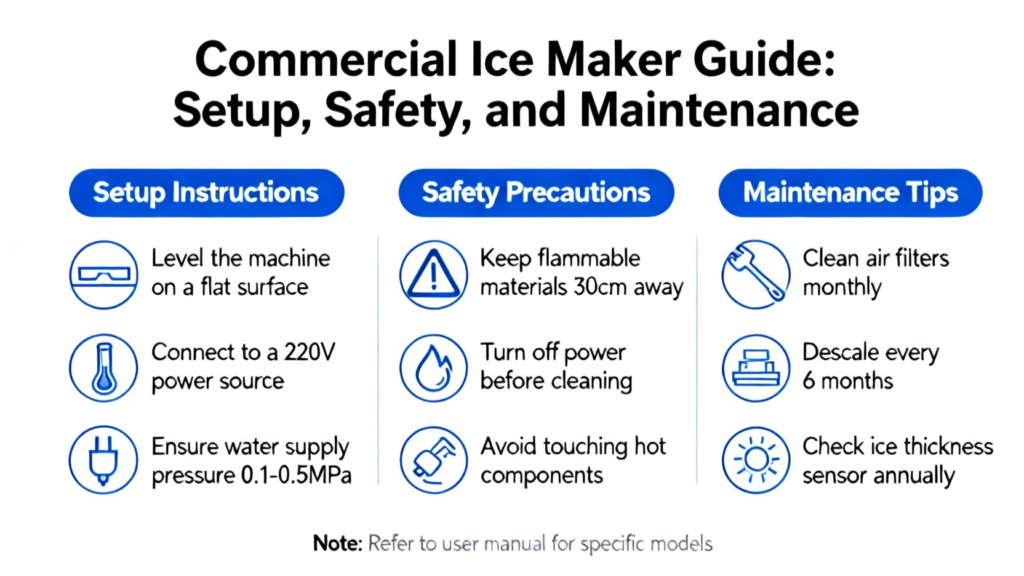
Before operation, strict safety and setup protocols must be followed. Upon delivery, the unit must remain upright for 24 hours to let the compressor oil settle, as emphasized in a Reddit discussion from November 2023 where users stress the importance of this step for longevity. The installation location requires at least 5.9 inches of clearance on all sides for airflow and must be away from heat sources and direct sunlight. Safety is paramount: never use an extension cord (which can overheat), keep the unit and cord away from flammable materials, and only use a potable water supply. The included three-prong plug and 70-inch cord are designed for this specific 780W load.
Optimizing Water Supply and Drainage
Proper water and waste management are non-negotiable for consistent ice production and machine health. The water supply pressure must be between 14.5 and 58 PSI; pressure outside this range requires a regulator or booster to prevent damage. Crucially, a gravity drain connection is mandatory. As ice melts in the storage bin, wastewater must exit freely. The drain pipe outlet must be lower than the machine’s drainage port to prevent backflow and internal water accumulation, which can cause failure. This aligns with common troubleshooting advice found in commercial appliance forums, where improper drainage is a frequent cause of service calls.
Ensuring Long-Term Performance and Output
For sustained optimal performance, understanding operational nuances is key. The ice making cycle time is influenced by ambient air temperature—warmer environments can slow production. It is strictly for indoor use, as outdoor conditions expose electrical components to moisture and temperature extremes. Only clean, potable water should be used; other liquids can damage the evaporator and contaminate ice. Regular cleaning following the manufacturer’s schedule is essential to prevent scale buildup and maintain hygiene. When configured correctly, a workhorse like the commercial stainless steel ice maker becomes a dependable asset.
In summary, a heavy-duty commercial ice maker is a significant investment that demands careful attention to installation and operation. Its durable stainless steel construction and efficient R290 system are built for high-volume, continuous use in businesses like restaurants and hotels. Success hinges on adhering to critical steps: allowing proper settling time after delivery, ensuring correct water pressure and mandatory drainage, and providing adequate clearance and a standard electrical connection. Ignoring these protocols, as highlighted by user experiences on platforms like Reddit, can lead to reduced efficiency, premature breakdowns, or safety hazards. By following the manufacturer’s guidelines for the 23.2 in. 500 lbs./24h Capacity Commercial Stainless Steel Ice Maker—from initial setup through daily use and maintenance—you secure a reliable ice supply that supports seamless service, maximizes the machine’s lifespan, and protects your operational investment. Ultimately, the machine’s reliability is a partnership between its robust engineering and your commitment to proper care.
This guide is a great reminder that proper setup and maintenance are key to keeping that commercial ice maker running reliably for years.
\}}
This guide is a great reminder that proper setup and maintenance are key to keeping that commercial ice maker running reliably for years.
\}}
This guide is a great reminder that proper setup and maintenance are key to keeping that commercial ice maker running reliably for years.
\}}
This guide is a great reminder that proper setup and maintenance are key to keeping that commercial ice maker running reliably for years.
\}}
This guide is a great reminder that proper setup and maintenance are key to keeping that commercial ice maker running reliably for years.
\}}
This guide is a great reminder that proper setup and maintenance are key to keeping that commercial ice maker running reliably.
\}}
This guide is a great reminder that proper setup and maintenance are key to keeping that commercial ice maker running reliably.
\}}
This guide is a great reminder that proper setup and maintenance are key to keeping that commercial ice maker running reliably.
\}}
This guide is a great reminder of how critical proper setup and maintenance are for that reliable commercial ice maker.
\}}
This guide is a great reminder of how critical proper setup and maintenance are for that reliable commercial ice maker.
\}}