
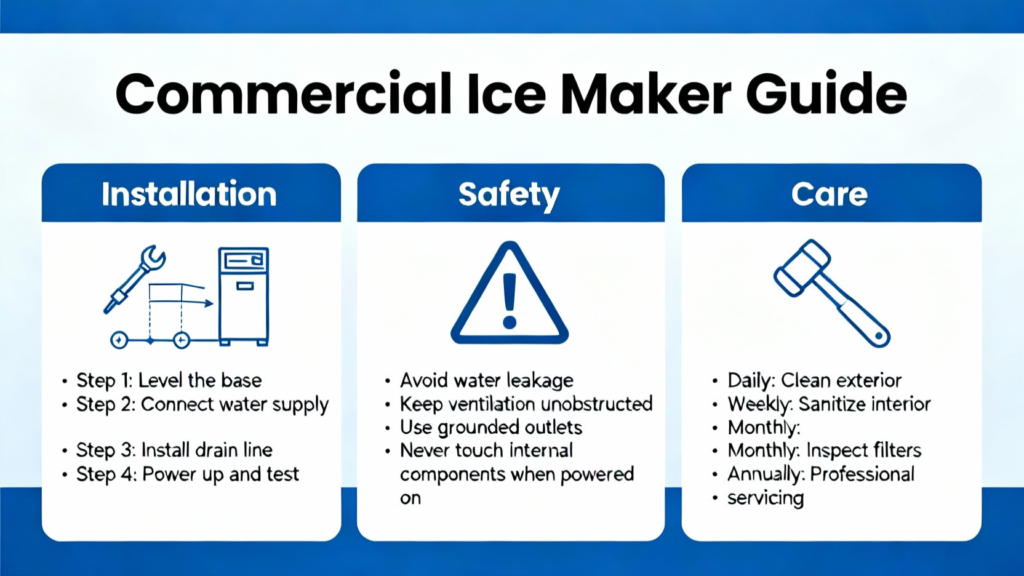
For restaurants, bars, and hotels, a reliable ice maker is a cornerstone of daily operations. This guide delves into the critical features, proper installation, and essential safety protocols for a heavy-duty commercial ice maker, ensuring you maximize its performance and longevity while safeguarding your business.
Engineering for Endurance: Core Specifications & Build
At the heart of this unit is its durable stainless steel construction, a material chosen for its corrosion resistance, ease of cleaning, and ability to withstand the rigors of a commercial kitchen. Operating on standard 110V 60Hz power with a 780W draw, it’s designed for accessibility in North American establishments. A key modern feature is the use of R290 (propane) refrigerant. According to Wikipedia, R290 has a “negligible ozone depletion potential and very low global warming potential” compared to traditional hydrofluorocarbons (HFCs), making it an environmentally progressive choice. Its compatibility with climate types SN, N, and ST means it can reliably perform in varied ambient temperatures, from subtropical to temperate environments.
Strategic Installation for Optimal Performance
Proper installation is non-negotiable for efficiency and safety. The unit requires a direct connection to a drinking water supply with a pressure between 14.5-58 psi; outside this range, a pressure changeover valve is mandatory. Critical clearance of at least 5.9 inches (15 cm) on all sides is required for adequate airflow and heat dissipation, a point often emphasized by professionals on forums like r/KitchenConfidential. Furthermore, the unit must be positioned with its drainage port connected to a gravity-fed system, where the outlet is lower than the ice maker’s port, to efficiently handle wastewater and melted ice. As noted in a refrigeration subreddit discussion, improper drainage is a leading cause of premature ice machine failure.
Critical Safety & Initial Startup Protocols
Adhering to safety guidelines protects both personnel and equipment. The ice maker is equipped with a three-prong plug and a 70-inch cord; using an extension cord is strongly discouraged as it can overheat and create a fire hazard. The unit must be kept away from flammable materials, direct sunlight, and heat sources like stoves. A crucial, often overlooked step is the 24-hour settling period after delivery. If the unit has been tilted, the refrigerant and compressor oil need time to settle before powering on, preventing compressor damage. This aligns with manufacturer recommendations widely cited in appliance discussions.
Operational Integrity & Long-Term Care
For sustained output, operational rules must be followed. Only use potable water to make ice; other liquids can damage the internal components and contaminate the ice. Understand that the surrounding environmental temperature directly influences ice production cycles; higher ambient temperatures will increase cycle times. Regular maintenance, including cleaning and sanitizing as per the manual, is essential to prevent scale and biological buildup, ensuring consistent ice quality and machine health. For businesses seeking a model that embodies these principles, the 23.23 in. 750 lbs./24h Capacity Commercial Stainless Steel Ice Maker is engineered to meet these rigorous demands.
Conclusion
Investing in a commercial ice maker like the stainless steel ice maker is a significant decision that impacts daily service flow. Its value is realized not just through its durable stainless steel construction and efficient R290 refrigerant system, but through meticulous installation and operation. As we’ve outlined, success hinges on providing correct water pressure, ensuring proper ventilation and drainage, and rigorously following safety and startup protocols—such as the critical 24-hour settling period. By integrating these practices, you transform a powerful appliance into a reliable asset. This approach mitigates common failure points, optimizes the impressive 750 lbs./24h capacity, and ensures your business has a consistent, hygienic ice supply. Ultimately, the longevity and performance of your commercial ice maker are directly tied to the care taken during setup and daily use, safeguarding your operation and supporting seamless customer service.
This guide is a must-read for anyone looking to ensure their commercial ice maker is installed safely and runs efficiently for years to come.
\}}
This guide is a must-read for anyone looking to ensure their commercial ice maker is installed safely and runs efficiently for years to come.
\}}
This guide is a must-read for anyone looking to ensure their commercial ice maker is installed safely and runs efficiently for years to come.
\}}
This guide is a must-read for anyone looking to ensure their commercial ice maker is installed safely and runs efficiently for years to come.
\}}
This guide is a must-read for anyone looking to ensure their commercial ice maker is installed safely and runs efficiently for years to come.
\}}
This guide is a must-read for anyone installing a commercial ice maker, as it perfectly balances performance tips with crucial safety steps.
\}}
This guide is a must-read for anyone installing a commercial ice maker, as it perfectly balances performance tips with crucial safety steps.
\}}
This guide is a must-read for anyone installing a commercial ice maker, as it perfectly balances performance tips with crucial safety steps.
\}}
This guide is a must-read for anyone installing a commercial ice maker, as it perfectly balances performance tips with crucial safety steps.
\}}
This guide is a must-read for anyone installing a commercial ice maker, as it perfectly balances performance tips with crucial safety steps.
\}}
Great guide—really highlights how a proper commercial ice maker installation is key for both safety and performance in a busy venue.
\}}
Great guide—really highlights how a proper commercial ice maker installation is key for both safety and performance in a busy venue.
\}}
Great guide—really highlights how a proper commercial ice maker installation is key for both safety and performance in a busy venue.
\}}