
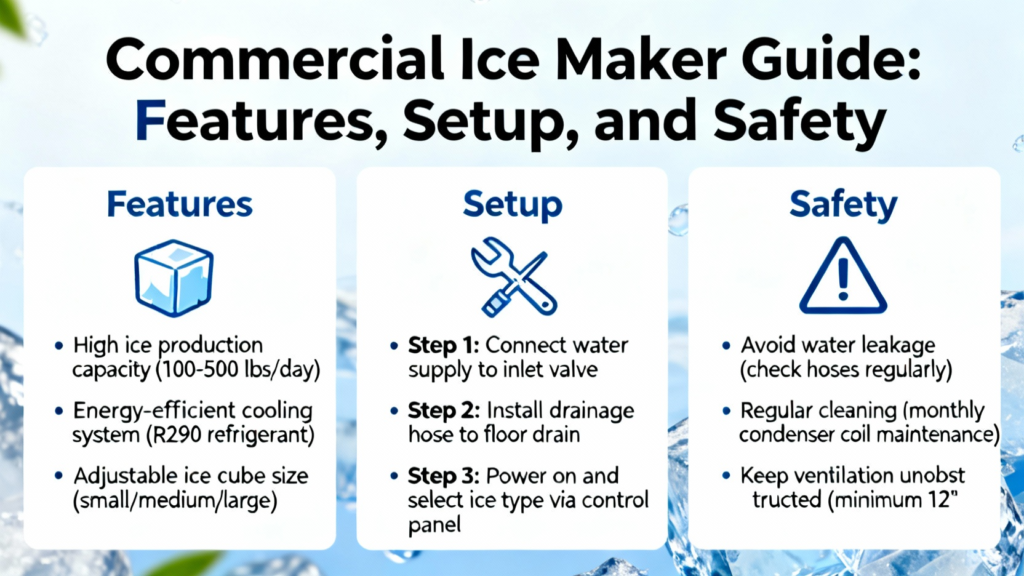
Investing in a heavy-duty commercial ice maker is a critical decision for any food service business. This comprehensive guide delves into the robust features of a premium stainless steel model, its optimal installation, and crucial safety protocols to ensure reliable, long-term performance for restaurants, bars, and hotels.
Engineering for Commercial Endurance
At its core, a true commercial ice maker is defined by its construction and components. The model in focus features a durable stainless steel exterior, which, as noted in discussions on commercial kitchen durability, is preferred for its resistance to corrosion, ease of cleaning, and professional appearance. Its operation on standard 110V/60Hz power (780W) makes it versatile for many North American establishments without requiring special electrical upgrades. A key modern feature is the use of R290 (propane) refrigerant. According to Wikipedia, R290 has a significantly lower Global Warming Potential (GWP) compared to traditional HFCs, aligning with stricter environmental regulations like those stemming from the 2016 Kigali Amendment to the Montreal Protocol. Its compatibility with climate types SN, N, and ST ensures stable performance from cool to tropical ambient temperatures.
Strategic Installation for Peak Performance
Proper installation is not just recommendation; it’s a requirement for efficiency and longevity. The unit’s dimensions (26.4” W x 23.2” D x 61.4” H) and substantial weight demand a planned location. Critical steps include:
- Water Line Connection: It must be connected to a potable water supply. As emphasized in professional forums, water pressure is critical; maintaining the specified range of 14.5-58 psi (0.1-0.4 MPa) prevents mechanical stress and ensures consistent ice production.
- Ventilation & Drainage: Leaving a minimum 15 cm (5.9 in) clearance on all sides allows for essential airflow, preventing compressor overheating. Equally important is connecting the gravity drain hose, ensuring its outlet is lower than the machine’s port to prevent water backup, a common point of failure noted in service threads.
- Initial Setup Protocol: After delivery, allowing the unit to stand upright for 24 hours lets compressor oil settle, a step often overlooked by eager users that can prevent immediate damage.
Non-Negotiable Safety & Operational Guidelines
Commercial equipment carries inherent risks that must be managed. The provided notes are a condensed safety manual. Key prohibitions include avoiding extension cords (a major fire hazard cited by electrical safety authorities), keeping the unit away from flammable materials and heat sources like stoves, and never using it outdoors where environmental factors can compromise electrical safety (Type I protection is for indoor use). Furthermore, using only water prevents contamination and system damage. The inclusion of a three-prong plug is for proper grounding, a fundamental aspect of commercial appliance safety to prevent electrocution.
Maximizing Longevity and Ice Quality
Beyond initial setup, long-term care dictates reliability. Environmental temperature directly impacts cycle times; a hotter kitchen means the unit works harder. Placing it away from direct sunlight mitigates this. Regular cleaning, as per manufacturer instructions, prevents scale buildup that can degrade ice quality and machine health over time. Understanding that meltwater will drain from the internal bin underscores the necessity of a permanent, proper drain connection. For businesses seeking a unit with these robust specifications, exploring a commercial stainless steel ice maker built to these standards is a wise step. Comparing it to other high-capacity models, like a 500 lbs./24h capacity commercial ice maker, helps in selecting the right output for your demand.
In conclusion, a heavy-duty commercial ice maker is a significant investment that, when selected and maintained correctly, becomes a backbone of daily operations. This analysis underscores that its value lies not only in its durable stainless steel construction and efficient R290 refrigerant system but fundamentally in its correct installation and operation. Adherence to the detailed guidelines on water pressure, ventilation, drainage, and electrical safety is what transforms a potential liability into a reliable asset. As evidenced by industry discussions on platforms like Reddit, the most common points of failure—scale buildup, improper drainage, and thermal overload—are almost entirely preventable with diligent setup and maintenance. By treating the installation notes as mandatory rather than suggestive, business owners can ensure their commercial ice maker delivers consistent, high-quality ice, maximizes its operational lifespan, and provides a full return on investment by supporting seamless service in high-demand environments like restaurants, bars, and catering.
This guide really helped me understand the key features to look for in a heavy-duty commercial ice maker before making an investment.
\}}
This guide really helped me understand the key features to look for in a heavy-duty commercial ice maker before making an investment.
\}}
This guide really helped me understand the key features to look for in a heavy-duty commercial ice maker before making an investment.
\}}
This guide really helped me understand the key features to look for in a heavy-duty commercial ice maker before making an investment.
\}}
This guide really helped me understand the key features to look for in a heavy-duty commercial ice maker before making an investment.
\}}
This guide really highlights why a heavy-duty commercial ice maker is such a smart investment for busy kitchens.
\}}
This guide really highlights why a heavy-duty commercial ice maker is such a smart investment for busy kitchens.
\}}
This guide really highlights why a heavy-duty commercial ice maker is such a smart investment for busy kitchens.
\}}
This guide really highlights why a heavy-duty commercial ice maker is such a smart investment for busy kitchens.
\}}
This guide really highlights why a heavy-duty commercial ice maker is such a smart investment for busy kitchens.
\}}
This guide really highlights why a heavy-duty commercial ice maker is such a smart investment for a busy kitchen.
\}}
This guide really highlights why a heavy-duty commercial ice maker is such a smart investment for a busy kitchen.
\}}