
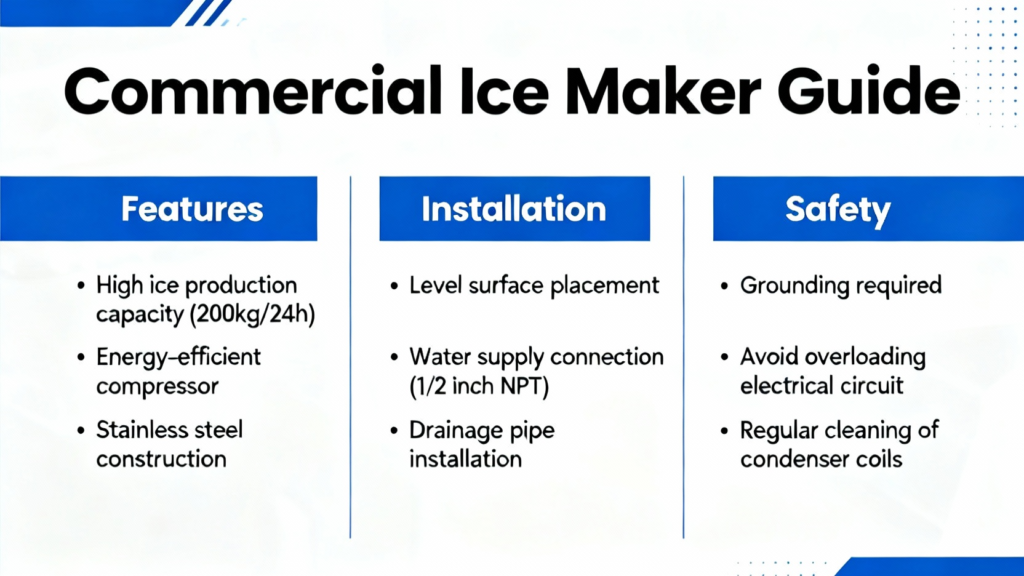
For any high-volume food service operation, a reliable ice maker is not a luxury—it’s a necessity. This guide delves into the critical features, installation requirements, and safety protocols for a heavy-duty commercial ice maker, ensuring you maximize performance and longevity while meeting the rigorous demands of a professional kitchen or bar.
Engineering for Endurance: Stainless Steel and R290 Refrigerant
At the core of this unit is its durable stainless steel construction, a material chosen for its exceptional resistance to corrosion, ease of cleaning, and ability to withstand the constant humidity and chemical cleaners used in commercial settings. This aligns with industry standards where hygiene and durability are paramount. Furthermore, it utilizes environmentally friendly R290 (propane) refrigerant. R290 has a significantly lower Global Warming Potential (GWP) compared to traditional hydrofluorocarbons (HFCs). As noted on Wikipedia, natural refrigerants like propane are gaining prominence due to environmental regulations, with R290 having a GWP of just 3, making it a future-proof choice for businesses conscious of their environmental impact. You can explore a unit built with these principles, like the 23.23 in. 750 lbs./24h Capacity Commercial Stainless Steel Ice Maker.
Installation Essentials: Space, Power, and Water Supply
Proper installation is non-negotiable for optimal function and safety. This model requires a standard 110V 60Hz outlet and draws 780W. Crucially, extension cords are not recommended due to the risk of overheating, a point often emphasized in professional discussions. On a Reddit thread about commercial appliance safety from March 2023, a user highlighted that “using an undersized extension cord on a high-draw appliance like an ice maker is a common fire hazard in restaurants.” The unit also requires a direct drinking water supply with a pressure between 14.5-58 psi. Water pressure outside this range can lead to machine failure, necessitating a pressure changeover valve. Equally important is providing at least 6 inches of clearance on all sides for adequate airflow, which ensures efficient heat exchange from the condenser.
Critical Safety and Initial Startup Protocol
Adhering to safety guidelines protects both your staff and your investment. The ice maker must be kept away from flammable materials and direct heat sources like stoves. It is equipped with a three-prong plug for proper grounding (Safety Protection Type I). Perhaps the most critical step is the 24-hour settling period after delivery. If the unit has been tilted during transport, the compressor oil can migrate into the refrigerant lines. Allowing it to sit upright for a full day lets the oil settle back, preventing compressor damage upon startup—a costly error. This is a universally mandated step for shipped refrigeration equipment.
Optimizing Performance and Drainage
To ensure consistent ice production, understand the operational parameters. The machine is rated for climate types SN, N, and ST, meaning it’s designed to perform reliably in varied ambient temperatures, though extreme heat will increase ice-making cycle times. Proper drainage is also vital. Since ice in the storage bin naturally melts, a gravity drain pipe must be connected before use, with its outlet lower than the machine’s drain port to prevent backflow. This prevents water accumulation and bacterial growth inside the unit. For operations requiring high-capacity output, a model such as the 750 lbs./24h Capacity Commercial Stainless Steel Ice Maker is engineered to handle such continuous demand.
In summary, integrating a heavy-duty commercial ice maker into your business is a significant investment that demands careful attention to detail. From its robust stainless steel build and eco-conscious R290 refrigerant to the non-negotiable installation requirements of proper clearance, dedicated power, and precise water pressure, each specification is designed to guarantee reliability. The critical safety protocols—especially the 24-hour settling period and proper grounding—are essential to prevent operational failures and hazards. By meticulously following the guidelines for drainage, ambient temperature management, and using only a potable water source, you ensure the unit operates at peak efficiency, delivering the consistent ice supply that hospitality and food service operations depend on. Ultimately, choosing a well-engineered commercial stainless steel ice maker and installing it correctly isn’t just about making ice; it’s about ensuring seamless service, safeguarding your investment, and supporting the relentless pace of a successful commercial environment.
This guide is a great reminder that a reliable commercial ice maker is a necessity, not a luxury, for keeping a busy kitchen running smoothly.
\}}
This guide is a great reminder that a reliable commercial ice maker is a necessity, not a luxury, for keeping a busy kitchen running smoothly.
\}}
This guide is a great reminder that a reliable commercial ice maker is a necessity, not a luxury, for keeping a busy kitchen running smoothly.
\}}
This guide is a great reminder that a reliable commercial ice maker is a necessity, not a luxury, for keeping things running smoothly.
\}}
This guide is a great reminder that a reliable commercial ice maker is a necessity, not a luxury, for keeping things running smoothly.
\}}
This guide is a great reminder that a reliable commercial ice maker is a necessity, not a luxury, for keeping things running smoothly.
\}}
This guide is a great reminder that a reliable commercial ice maker is a necessity, not a luxury, for keeping things running smoothly.
\}}