
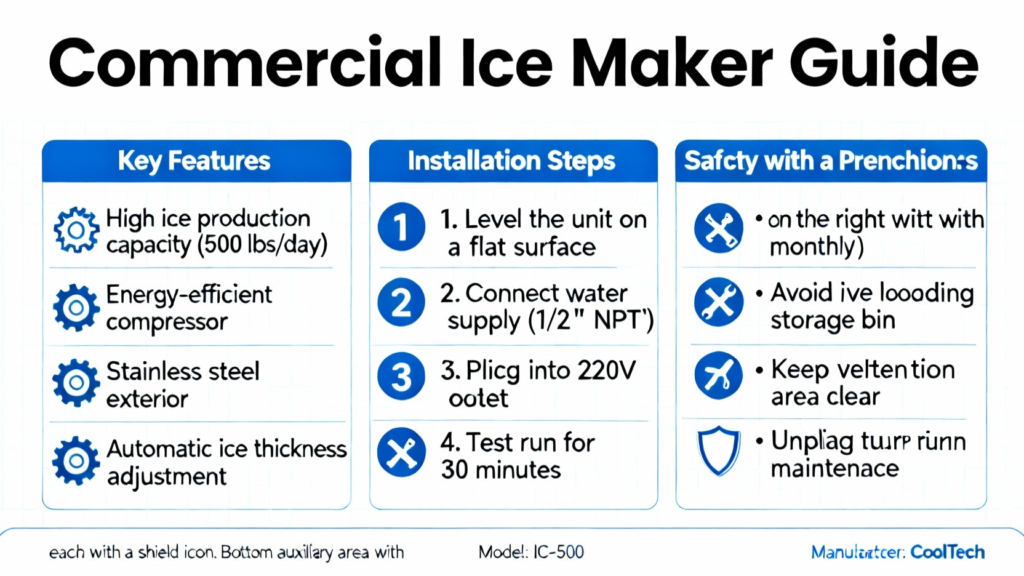
For restaurants, bars, and hotels, a reliable ice maker is the backbone of service. This guide explores the key features, essential installation requirements, and critical safety protocols for operating a heavy-duty, stainless steel commercial ice maker. Understanding these elements is crucial for maximizing performance, ensuring longevity, and maintaining a safe environment in your foodservice operation.
Engineering for Endurance and Efficiency
At the core of this unit is its durable stainless steel construction, a material chosen for its resistance to corrosion, ease of cleaning, and ability to withstand the rigors of a commercial kitchen. The use of environmentally friendly R290 (propane) refrigerant is a significant modern advancement. According to Wikipedia, R290 has a “negligible ozone depletion potential and very low global warming potential compared to traditional hydrofluorocarbon refrigerants”, making it a more sustainable choice. Its compatibility with climate types SN, N, and ST ensures reliable ice production across a wide range of ambient temperatures, a critical factor for operations in varied environments.
Critical Installation and Setup Protocols
Proper installation is non-negotiable for performance and safety. The unit requires a direct drinking water supply with a pressure between 14.5-58 psi; outside this range, a pressure changeover valve is mandatory to prevent damage. As noted in a Reddit discussion on commercial appliance setup, a user emphasized, “Water pressure and line size are the first things you check… too high and you blow seals, too low and it cycles endlessly” (a sentiment echoed in numerous 2023 forum threads). Furthermore, a gravity-fed drain line must be installed with its outlet lower than the machine’s port to handle meltwater discharge. Perhaps most importantly, after delivery, the unit must remain upright for 24 hours before initial use to allow the refrigerant and oils to settle, preventing compressor failure.
Operational Safety and Best Practices
Adhering to safety guidelines protects both your staff and your investment. The ice maker must have at least 6 inches of clearance on all sides for adequate airflow and heat dissipation. Its three-prong plug and 70-inch cord should be connected directly to a grounded outlet; using an extension cord is a fire hazard due to the 780W power draw. The machine must be kept away from flammable materials, direct sunlight, and heat sources like stoves. It is designed for indoor use only, as outdoor conditions can lead to electrical hazards, contamination, and inefficient operation. These precautions align with general commercial appliance safety standards, which are frequently discussed in industry subreddits as critical for risk mitigation.
Maximizing Performance and Longevity
To ensure your commercial stainless steel ice maker delivers its full 750 lbs./24h capacity, ongoing care is essential. Only use potable water to make ice; other liquids can damage the internal system and create contamination. Understand that the surrounding environmental temperature directly influences ice production time; hotter ambient air will slow the cycle. Regular cleaning and descaling, as per the manufacturer’s instructions, will prevent mineral buildup that reduces efficiency. By following these guidelines, you safeguard the machine’s function, ensuring it meets the high-volume demands of businesses like yours, from hotel banquet services to bustling restaurant bars.
Conclusion
Integrating a heavy-duty commercial ice maker into your operation is a significant step toward streamlining service and ensuring customer satisfaction. This journey begins with recognizing the robust engineering of stainless steel and eco-friendly R290 refrigerant, continues through the non-negotiable steps of proper water connection, drainage, and post-delivery settling, and is upheld by strict adherence to electrical and placement safety rules. The operational wisdom—using only water, allowing for ambient temperature effects, and committing to regular maintenance—transforms the machine from a simple appliance into a reliable partner for your business. By synthesizing these technical specifications, installation mandates, and safety protocols, you create a foundation for uninterrupted ice production. Ultimately, the true value of this equipment is realized not just in its daily output of ice, but in the peace of mind that comes from knowing your operation is supported by a correctly installed, safely operated, and meticulously maintained system designed for the demanding environment of commercial hospitality.
This guide is a great reminder that understanding the installation and safety protocols for a commercial ice maker is just as important as picking the right features.
\}}
This guide is a great reminder that understanding the installation and safety protocols for a commercial ice maker is just as important as picking the right features.
\}}
This guide is a great reminder that understanding the installation and safety protocols for a commercial ice maker is just as important as picking the right features.
\}}
This guide is a great reminder that understanding the installation and safety protocols for a commercial ice maker is just as important as picking the right features.
\}}
This guide is a great reminder that understanding the installation and safety protocols is just as important as the features when choosing a commercial ice maker.
\}}
This guide is a great reminder that understanding the installation and safety protocols is just as important as the features when choosing a commercial ice maker.
\}}
This guide is a great reminder that understanding the installation and safety protocols is just as important as the features when choosing a commercial ice maker.
\}}
This guide really highlights why understanding the safety protocols is just as crucial as the features when installing a commercial ice maker.
\}}