
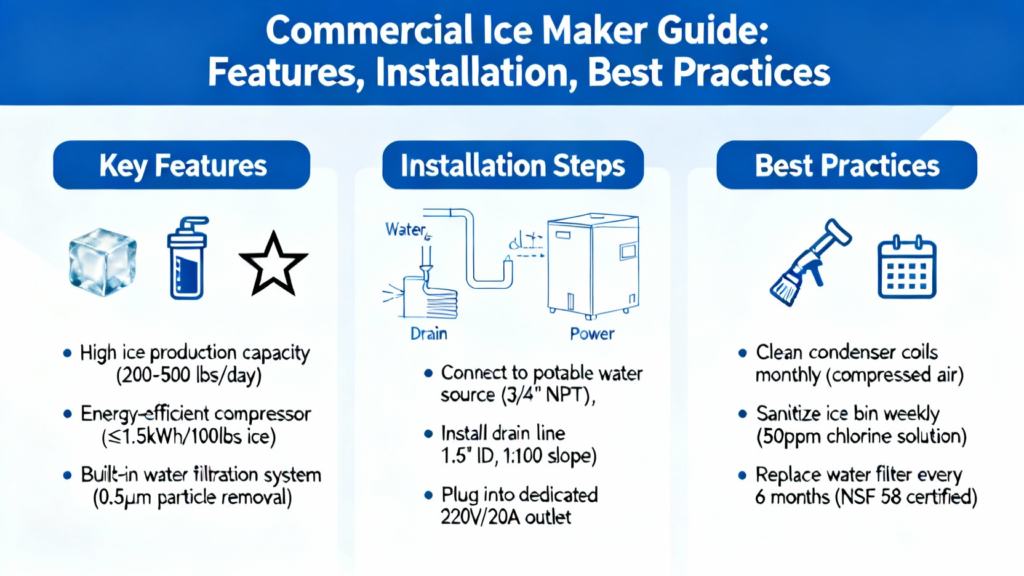
For any high-volume food service operation, a reliable ice maker is the unsung hero of the kitchen. This guide delves into the essential features, critical installation requirements, and operational best practices for a heavy-duty commercial ice maker, ensuring you maximize performance, safety, and longevity for your business.
Engineering for Endurance: Core Specifications & Build
At the heart of a dependable commercial unit is its construction and design. This model features a fully durable stainless steel construction, which is the industry standard for corrosion resistance, hygiene, and longevity in demanding environments like restaurants and bars. It operates on standard 110V 60Hz power with a 780W draw, making it compatible with most North American commercial kitchens without requiring special electrical upgrades. A key modern feature is the use of environmentally friendly R290 (propane) refrigerant. According to Wikipedia, R290 has a “negligible ozone depletion potential and very low global warming potential” compared to traditional hydrofluorocarbons (HFCs), making it a more sustainable choice. Its compatibility with climate types SN, N, and ST ensures reliable ice production across a wide range of ambient temperatures.
Foundations for Success: Installation & Setup
Proper installation is non-negotiable for optimal function. The unit requires a direct connection to a drinking water supply with a specific pressure range of 14.5-58 psi; outside this range, a pressure changeover valve is mandatory to prevent damage. Critical spatial requirements include maintaining at least 5.9 inches of clearance on all sides for airflow and connecting a gravity-fed drain pipe with its outlet lower than the machine’s. A vital, often overlooked step is to let the unit stand upright for 24 hours after delivery before initial use. As discussed in a Reddit thread on appliance installation (2023), this settling period allows compressor oil, which may have shifted during transit, to flow back, preventing premature failure.
Operational Integrity: Safety & Best Practices
Adhering to safety guidelines protects both your staff and your investment. The ice maker comes with a three-prong plug and a 70-inch cord; using an extension cord is strongly discouraged as it can overheat and pose a fire risk, a concern echoed by electrical safety experts. The unit must be kept away from flammable materials, direct sunlight, and heat sources like stoves, which can force the compressor to overwork. It is designed for indoor use only and should only use plain water to make ice, as other liquids can damage the system and contaminate ice. Regular cleaning and descaling, as recommended by manufacturers, are also crucial for maintaining ice quality and machine efficiency over time.
Maximizing Output & Understanding Variables
To achieve the stated production capacity, operators must understand influencing factors. The surrounding environmental temperature directly impacts ice-making cycle times; a hotter kitchen will typically lead to longer cycle times and potentially lower daily output. The machine’s design utilizes a gravity drainage system for wastewater, meaning proper drain setup is essential to prevent malfunctions. For operations needing robust output, selecting a model with ample capacity is key, such as the 23.23 in. 750 lbs./24h Capacity Commercial Stainless Steel Ice Maker. It’s important to note that published capacities are based on ideal laboratory conditions (e.g., 70°F air and 50°F water), as noted in industry discussions, so real-world output may vary.
Conclusion
Investing in a heavy-duty commercial ice maker is a significant decision that impacts daily service flow. This analysis underscores that beyond the robust stainless steel construction and efficient R290 refrigerant system, the true reliability of the unit is built on meticulous installation—from water pressure compliance and mandatory clearance to the critical 24-hour settling period. Operational vigilance, including adhering to electrical safety, proper placement, and using only water, ensures safety and prolongs the machine’s lifespan. Furthermore, understanding that real-world ice production is influenced by ambient temperature and setup allows for realistic expectations and planning. By treating your commercial ice maker as a precision piece of kitchen equipment requiring specific conditions and care, you secure a consistent, high-quality ice supply that keeps service running smoothly and customers satisfied, ultimately protecting your operational investment for years to come.
This guide is a lifesaver for understanding the critical installation requirements of a commercial ice maker before you buy.
\}}
This guide is a lifesaver for understanding the critical installation requirements of a commercial ice maker before you buy.
\}}
This guide is a lifesaver for understanding the critical installation requirements of a commercial ice maker before you buy.
\}}
This guide is a lifesaver for understanding the critical installation requirements of a commercial ice maker before you buy.
\}}
This guide is a lifesaver for understanding the critical installation requirements of a commercial ice maker before you buy.
\}}
This guide is a lifesaver for anyone trying to navigate the critical installation and best practices for a commercial ice maker.
\}}
This guide is a lifesaver for anyone trying to navigate the critical installation and best practices for a commercial ice maker.
\}}
This guide is a lifesaver for anyone trying to navigate the critical installation and best practices for a commercial ice maker.
\}}