
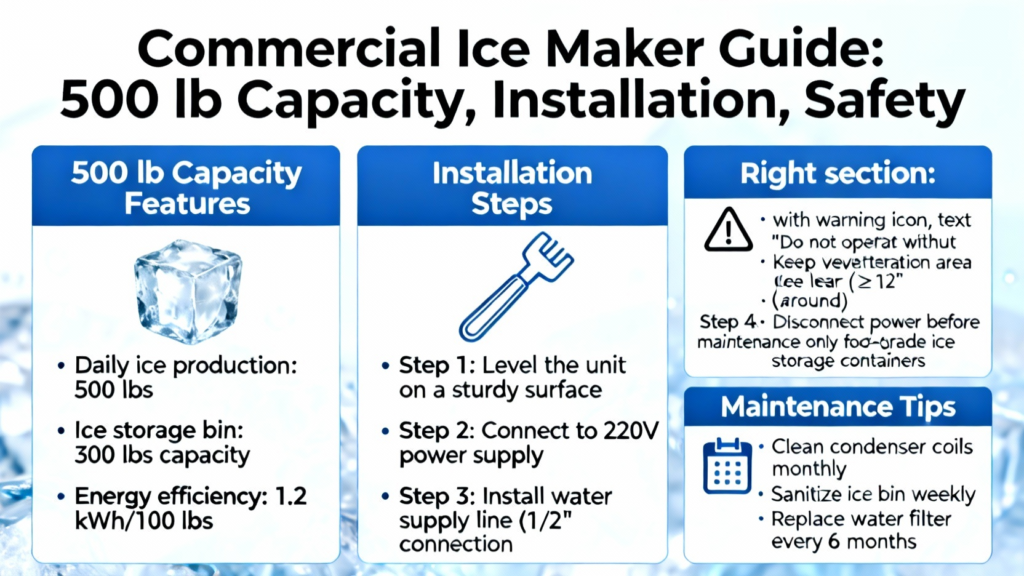
For restaurants, bars, and hotels, a reliable ice maker is a cornerstone of daily operations. This guide delves into the essential specifications and critical installation requirements of a heavy-duty 500 lb./24h commercial ice maker. We’ll explore its durable construction, optimal setup for safety and performance, and the vital steps for proper installation and maintenance to ensure longevity and consistent ice production.
Engineering for Endurance: Stainless Steel and R290 Refrigerant
At the core of this commercial ice maker is its durable stainless steel construction, chosen for its resistance to corrosion, ease of cleaning, and ability to withstand the rigors of a high-volume kitchen environment. This material aligns with industry standards for food service equipment, ensuring hygiene and durability. Powering its cooling system is the environmentally friendly R290 refrigerant, a propane-based solution with a low Global Warming Potential (GWP). As noted on Wikipedia, natural refrigerants like R290 are seeing increased adoption due to environmental regulations phasing out potent greenhouse gases. Its compatibility with climate types SN, N, and ST ensures reliable performance across varied temperate environments, a crucial feature for consistent operation.
For a unit matching these specifications, you can explore the 23.2 in. 500 lbs./24h Capacity Commercial Stainless Steel Ice Maker.
Pre-Installation Essentials: Space, Power, and Water Supply
Proper installation begins long before the unit is plugged in. This ice maker requires a dedicated drinking water supply with a specific water pressure of 14.5-58 psi. Pressure outside this range necessitates a changeover valve to prevent mechanical issues. Equally important is ventilation: a minimum 5.9 inches (15 cm) of clearance on all sides is mandatory for airflow and heat dissipation. The electrical requirements are specific: a 110V 60Hz outlet must be nearby, as using an extension cord is strongly discouraged due to overheating and fire risks, a point often emphasized by commercial kitchen managers on forums like r/KitchenConfidential. The included three-prong plug and 70-inch cord are designed for this direct connection.
Critical Safety and Initial Startup Protocol
Adhering to safety protocols protects both personnel and equipment. The unit must be kept away from flammable materials and heat sources like stoves or direct sunlight. It is designed for indoor use only. The most critical step occurs upon delivery: after transport, the unit must be left upright for 24 hours to allow the compressor oil to settle. As discussed in appliance repair communities, failing to do this can cause immediate compressor failure. Furthermore, you must connect the gravity drain pipe before operation, as meltwater from the inner tank needs a proper exit path, with the drain outlet positioned lower than the machine’s port.
Optimizing Performance and Long-Term Operation
Once operational, understanding a few key factors will maintain peak efficiency. The surrounding environmental temperature directly influences ice-making cycle times; a hotter ambient room will reduce production speed. Regular cleaning with approved solutions is vital to prevent scale and biological growth—never use any liquid other than water to make ice. For high-volume needs, consider the capacity of the Commercial Stainless Steel Ice Maker. Finally, the unit’s net weight of 145.51 lbs and dimensions of 26.4” W x 23.2” D x 61.4” H confirm its substantial, space-optimized build for permanent installation in a busy service area.
In summary, maximizing the return on your commercial ice maker investment hinges on a meticulous approach to its setup and care. This isn’t merely plug-and-play appliance; it’s a piece of professional machinery requiring specific water pressure, dedicated electrical connection, proper ventilation spacing, and a crucial settling period after delivery. Ignoring these parameters, such as using an extension cord or skipping the 24-hour upright rest, can lead to immediate failure or a shortened lifespan, as echoed by service technicians in online discussions. By respecting its engineered requirements—from the environmentally conscious R290 refrigerant to the mandatory drain connection—you ensure the durable stainless steel construction translates into years of reliable, high-volume ice production. Ultimately, treating this ice maker with the same operational rigor as any other critical kitchen equipment is the key to keeping your service flowing smoothly and your customers satisfied.
This guide is a great breakdown of what to look for when installing a reliable 500 lb ice maker.
\}}
This guide is a great breakdown of what to look for when installing a reliable 500 lb ice maker.
\}}
This guide is a great breakdown of what to look for when installing a reliable 500 lb ice maker.
\}}
This guide is a great breakdown of what to look for when installing a heavy-duty 500 lb. ice maker for busy operations.
\}}
This guide is a great breakdown of what to look for when installing a heavy-duty 500 lb. ice maker for busy operations.
\}}
This guide is a great breakdown of what to look for when installing a heavy-duty 500 lb. ice maker for busy operations.
\}}
This guide is a great breakdown of what to look for when installing a heavy-duty 500 lb. commercial ice maker.
\}}
This guide is a great breakdown of what to look for when installing a heavy-duty 500 lb. commercial ice maker.
\}}
This guide is a great breakdown of what to look for when installing a heavy-duty 500 lb. commercial ice maker.
\}}
This guide is a great breakdown of what to look for when installing a heavy-duty 500 lb. commercial ice maker.
\}}