
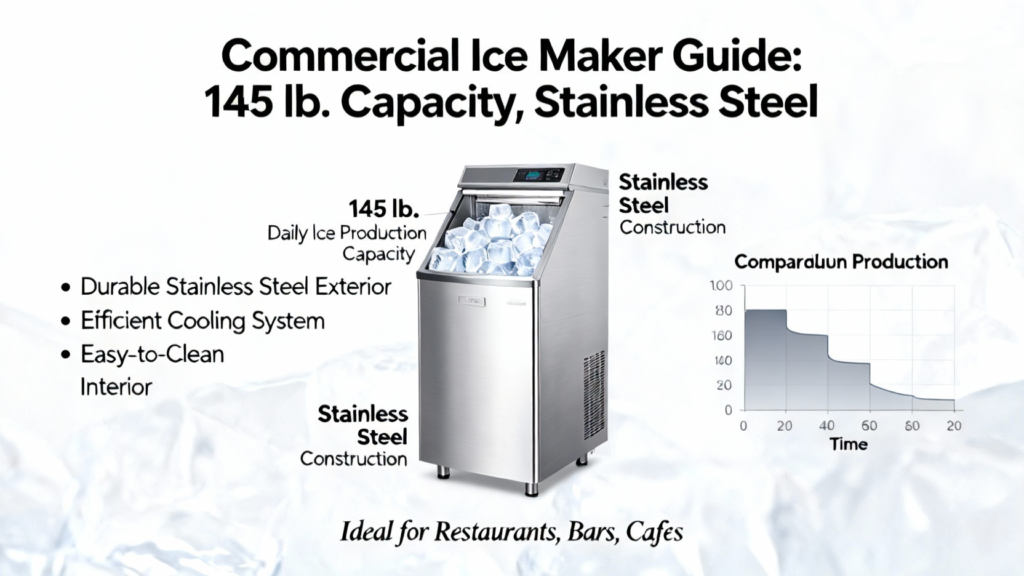
For any high-volume food service operation, a reliable ice maker is a cornerstone of daily service. This guide delves into the critical features, proper installation, and essential safety protocols for a heavy-duty 145 lb. capacity stainless steel commercial ice maker. Understanding these elements is key to ensuring peak performance, longevity, and safety in your restaurant, bar, or hotel.
Engineering for Commercial Durability and Efficiency
At the heart of this unit is its stainless steel construction, a material chosen for its exceptional corrosion resistance and ease of cleaning in demanding environments. The use of R290 (propane) refrigerant is a significant modern advancement. According to Wikipedia, R290 has a “negligibly low ozone depletion potential and very low global warming potential” compared to traditional hydrofluorocarbons, making it an environmentally responsible choice. Furthermore, its compatibility with climate types SN, N, and ST (Subnormal, Normal, and Subtropical) ensures reliable ice production across a wide range of ambient temperatures, a feature critical for operations in varied geographic locations.
Critical Installation and Setup Requirements
Proper installation is non-negotiable for performance and safety. The unit requires a dedicated drinking water supply with a precise pressure range of 14.5-58 PSI. As noted in a Reddit discussion on r/refrigeration, improper water pressure is a common cause of ice maker failure, leading to scale buildup or mechanical damage. Equally important is ventilation; maintaining at least 6 inches of clearance on all sides allows heat from the condenser to dissipate. A gravity-fed drain connection, positioned lower than the machine’s outlet, is mandatory to handle continuous meltwater discharge, preventing internal flooding and bacterial growth.
Essential Safety and Operational Protocols
Adhering to safety guidelines protects both your staff and your investment. The included three-prong plug requires a properly grounded outlet, and using an extension cord is explicitly warned against due to fire risk from overheating—a point often emphasized by commercial kitchen managers online. Before initial use, a 24-hour settling period after delivery is crucial to allow compressor oil to settle, preventing severe damage. The machine must be kept away from heat sources and direct sunlight, as ambient temperature directly impacts freeze cycles and efficiency. As one user on r/KitchenConfidential highlighted, “[Ice machine] placement is everything. Putting it next to the oven is a surefire way to kill it.”
Maximizing Longevity and Ice Quality
For sustained performance, operational discipline is key. Only use potable water to make ice; introducing other liquids can damage the evaporator and contaminate the system. Regular cleaning, as per the manufacturer’s schedule, prevents scale and slime mold—common culprits of downtime. It’s also vital to understand that ice production time varies with room temperature; a hotter kitchen environment will naturally slow production. For operations seeking a unit that embodies these principles of durability and efficiency, the 26.4 in. 145 lb. Capacity Commercial Stainless Steel Ice Maker is engineered to meet these rigorous demands.
Conclusion
Investing in a commercial ice maker like the 145 lb. capacity stainless steel model is a significant decision that impacts daily operations. This article has outlined the core aspects that ensure you get the most from your equipment: from its durable stainless steel build and eco-friendly R290 refrigerant to the non-negotiable installation requirements of proper water pressure, ventilation, and drainage. We’ve underscored critical safety protocols, such as avoiding extension cords and allowing for proper settling time, which are consistently echoed by industry professionals on forums like r/refrigeration and r/KitchenConfidential. Ultimately, the reliability of your commercial ice maker hinges on respecting these engineering and operational guidelines. By following them, you secure a consistent supply of ice, minimize costly repairs, and ensure this vital piece of equipment serves your business reliably for years to come, proving itself as a true workhorse in your commercial kitchen or bar.
This guide really highlights why a reliable **commercial ice maker** is so essential for keeping a busy kitchen running smoothly.
\}}
This guide really highlights why a reliable **commercial ice maker** is so essential for keeping a busy kitchen running smoothly.
\}}
This guide really highlights why a reliable **commercial ice maker** is so essential for keeping a busy kitchen running smoothly.
\}}
This guide really highlights why a reliable **commercial ice maker** is so essential for keeping a busy kitchen running smoothly.
\}}
This guide really highlights why a reliable **commercial ice maker** is so essential for keeping a busy kitchen running smoothly.
\}}
This guide really highlights why a reliable commercial ice maker is so essential for busy kitchens.
\}}
This guide really highlights why a reliable commercial ice maker is so essential for busy kitchens.
\}}
This guide really highlights why a reliable commercial ice maker is so essential for busy kitchens.
\}}
This guide really highlights why a reliable commercial ice maker is so essential for busy kitchens.
\}}
This guide really highlights why a reliable commercial ice maker is so essential for busy kitchens.
\}}
This guide really highlights why a reliable commercial ice maker is so crucial for busy kitchens.
\}}
This guide really highlights why a reliable commercial ice maker is so crucial for busy kitchens.
\}}
This guide really highlights why a reliable commercial ice maker is so crucial for busy kitchens.
\}}