
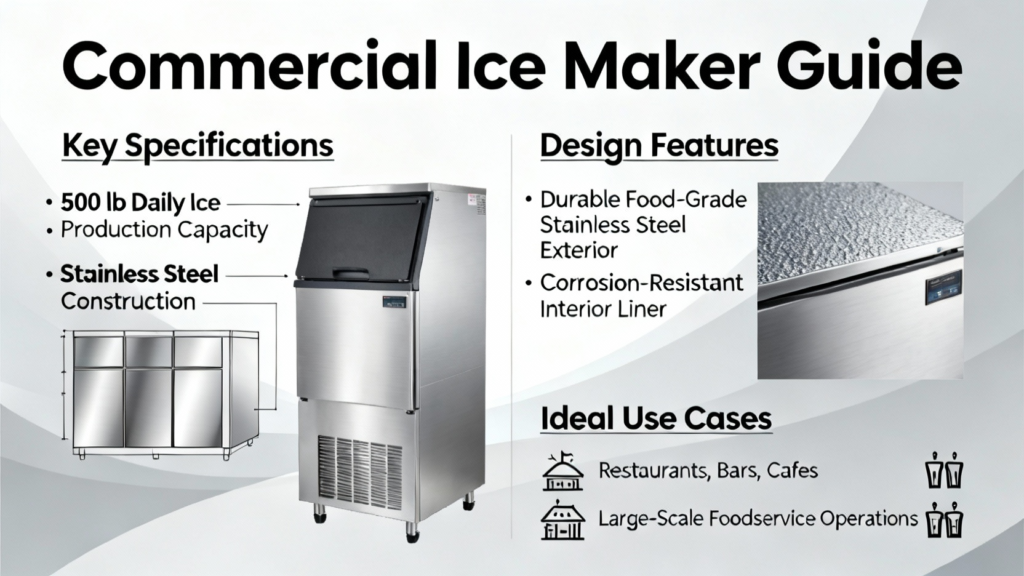
For restaurants, bars, and hotels, a reliable ice maker is the backbone of service. This guide explores the robust features of a heavy-duty 500 lb./24h capacity commercial ice maker, focusing on its durable stainless steel construction, efficient operation, and critical installation requirements. Understanding these elements is key to ensuring peak performance, longevity, and safety in a demanding commercial environment.
Engineering for Endurance: Stainless Steel and R290 Refrigerant
At the core of this ice maker’s reliability is its durable stainless steel construction. This material is industry-standard for commercial kitchens due to its exceptional corrosion resistance, ease of cleaning, and structural integrity, which prevents warping under constant use. Paired with this is the use of environmentally friendly R290 refrigerant. R290, or propane, is a natural refrigerant with a very low Global Warming Potential (GWP). As noted on Wikipedia, natural refrigerants like R290 are gaining prominence due to environmental regulations phasing out synthetic alternatives, though they require careful handling due to flammability. This unit’s Safety Protection Type I classification indicates it is built to manage these properties safely within its design.
Power, Placement, and Prerequisites for Operation
Proper installation is non-negotiable for performance and safety. This unit operates on standard 110V 60Hz power with a 780W draw and includes a 70″ three-prong plug. Crucially, extension cords are not recommended due to the risk of overheating, a point often emphasized in commercial equipment discussions. Placement requires at least 5.9 inches of clearance on all sides for airflow, away from heat sources and direct sunlight. The machine must be connected to a drinking water supply with a pressure between 14.5-58 psi; outside this range, a changeover valve is mandatory. As highlighted in a Reddit discussion on refrigeration in November 2023, improper water pressure is a common cause of ice maker failure, leading to low ice production or mechanical damage.
Critical Startup and Safety Protocols
Before first use, specific protocols must be followed. Upon delivery, the unit must remain upright for 24 hours to allow compressor oil to settle, a standard procedure for shipped refrigeration equipment. Furthermore, it must never be used with any liquid other than water to make ice. A vital and often overlooked step is the drainage connection. Since ice in the storage bin melts, a gravity drain pipe must be installed with its outlet lower than the machine’s port to prevent water accumulation and bacterial growth. This aligns with food safety best practices, as standing water in equipment can become a health hazard.
Optimizing Performance in Varied Environments
This ice maker is designed for Climate types SN, N, ST, meaning it can operate reliably in subtropical, temperate, and tropical environments. However, the surrounding environmental temperature will influence ice making time, with higher ambient temperatures potentially reducing production speed. It is designed for indoor use only; outdoor operation is not recommended. For operations seeking a unit with these specific robust features, exploring a model like the 23.2 in. 500 lbs./24h Capacity Commercial Stainless Steel Ice Maker provides a clear example of a machine built to these commercial standards. The importance of climate compatibility is underscored in HVAC literature, as condenser efficiency is directly impacted by ambient conditions.
Conclusion
Investing in a heavy-duty commercial ice maker like the 500 lb./24h stainless steel model is a significant decision that impacts daily operations. Its value lies not only in its durable construction and efficient use of R290 refrigerant but, critically, in its correct installation and operation. From ensuring proper water pressure and mandatory drainage to allowing for adequate settling time and spatial clearance, each step outlined is foundational to achieving the advertised performance and lifespan. Neglecting these protocols, as evidenced by common failure points discussed by professionals, can lead to reduced efficiency, costly repairs, or even safety hazards. Ultimately, this commercial ice maker represents a powerful tool for any foodservice business. By respecting its engineering requirements—the power needs, environmental limits, and meticulous setup—operators can ensure it delivers a consistent, reliable supply of ice, thereby supporting seamless service and contributing to the overall success and safety of their commercial establishment.
This guide really highlights why that durable stainless steel construction is so crucial for a busy restaurant’s 500 lb. ice maker.
\}}
This guide really highlights why that durable stainless steel construction is so crucial for a busy restaurant’s 500 lb. ice maker.
\}}
This guide really highlights why that durable stainless steel construction is so crucial for a busy restaurant’s 500 lb. ice maker.
\}}
This guide really highlights why that durable stainless steel construction is so crucial for a busy restaurant’s 500 lb. ice maker.
\}}
This guide really highlights why that durable stainless steel construction is so crucial for a busy restaurant’s 500 lb. ice maker.
\}}
This guide really highlights why a durable stainless steel commercial ice maker is such a crucial investment for busy venues.
\}}
This guide really highlights why a durable stainless steel commercial ice maker is such a crucial investment for busy venues.
\}}
This guide really highlights why a durable stainless steel commercial ice maker is such a crucial investment for busy venues.
\}}
This guide really highlights why a durable stainless steel commercial ice maker is such a crucial investment for busy venues.
\}}
This guide really highlights why a durable stainless steel commercial ice maker is such a crucial investment for busy venues.
\}}
This guide really highlights why a durable stainless steel commercial ice maker is such a crucial investment for busy kitchens.
\}}
This guide really highlights why a durable stainless steel commercial ice maker is such a crucial investment for busy kitchens.
\}}
This guide really highlights why a durable stainless steel commercial ice maker is such a crucial investment for busy kitchens.
\}}
This guide is super helpful for understanding why a durable stainless steel commercial ice maker is such a critical investment for busy operations.
\}}
This guide is super helpful for understanding why a durable stainless steel commercial ice maker is such a critical investment for busy operations.
\}}
This guide is super helpful for understanding why a durable stainless steel commercial ice maker is such a critical investment for busy operations.
\}}
This guide really highlights why a durable stainless steel commercial ice maker is such a crucial investment for high-volume operations.
\}}
This guide really highlights why a durable stainless steel commercial ice maker is such a crucial investment for high-volume operations.
\}}
This guide really highlights why a durable stainless steel commercial ice maker is such a crucial investment for busy venues.
\}}
This guide really highlights why a durable stainless steel commercial ice maker is a game-changer for busy kitchens.
\}}