
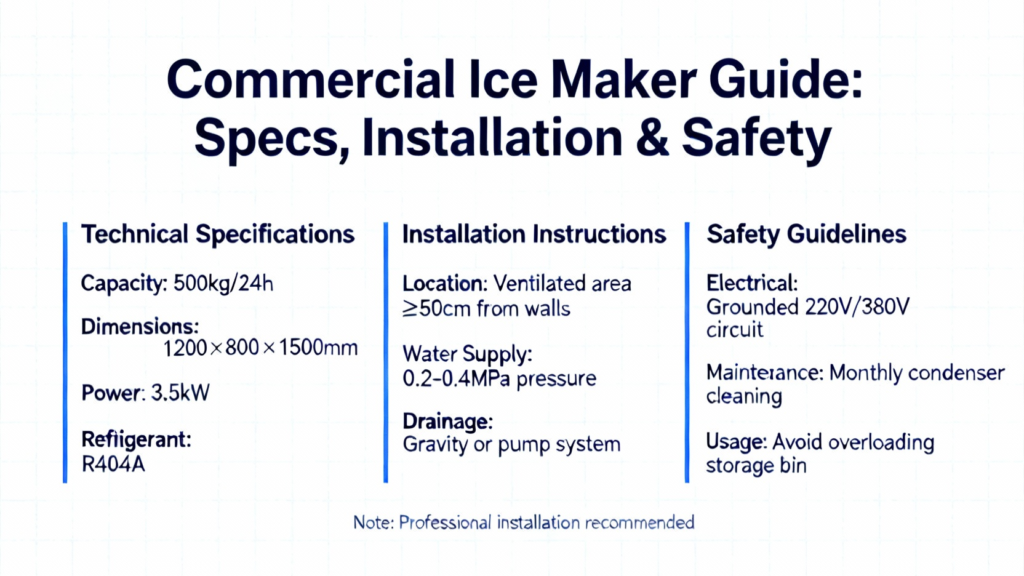
For any bustling foodservice operation, a reliable ice maker is the unsung hero of the back-of-house. This guide delves into the critical specifications and essential installation requirements of a heavy-duty commercial ice maker, focusing on the 23.23 in. 750 lbs./24h Capacity Commercial Stainless Steel Ice Maker. Understanding these details is key to ensuring optimal performance, longevity, and safety in demanding environments like restaurants, bars, and hotels.
Engineering for Commercial Endurance
At its core, a commercial ice maker is defined by its robust construction and efficient design. The unit in question features a durable stainless steel exterior, a standard for the industry due to its corrosion resistance and ease of cleaning, as noted in discussions on equipment longevity in the r/KitchenConfidential subreddit. It operates on a standard 110V/60Hz circuit, drawing 780W of power. Crucially, it utilizes R290 (propane) refrigerant, an environmentally friendly hydrocarbon with a low Global Warming Potential (GWP), a shift supported by global environmental regulations like the Kigali Amendment to the Montreal Protocol (Wikipedia). Its compatibility with varied climate types (SN, N, ST) ensures reliable ice production in different ambient temperatures.
Critical Pre-Installation Protocols
Proper setup begins long before the first batch of ice. Upon delivery, the unit must remain upright for 24 hours to allow the compressor oil to settle, a critical step often emphasized by technicians to prevent damage. The installation site requires a dedicated drinking water supply line with a pressure between 14.5-58 psi; outside this range, a pressure changeover valve is mandatory. Furthermore, a gravity-fed drain line must be connected, with its outlet positioned lower than the machine’s port to ensure proper wastewater discharge, a common point of failure if neglected. Adequate ventilation is non-negotiable—a minimum of 6 inches of clearance on all sides is required for heat dissipation.
Operational Safety and Best Practices
Safe operation protects both your staff and your investment. The ice maker comes with a three-prong plug and a 70-inch cord; using an extension cord is strongly discouraged as it can overheat and pose a fire risk, a warning frequently echoed in restaurant owner forums. The unit must be kept away from direct sunlight, stoves, or other heat sources, and never used outdoors. Only potable water should be used, as other liquids can damage the internal components and contaminate ice. It’s also vital to remember that ice production time is influenced by the surrounding ambient temperature, with warmer environments typically slowing the cycle.
Maximizing Longevity and Performance
To ensure your commercial stainless steel ice maker delivers its 750 lbs./24h capacity consistently, adherence to maintenance guidelines is key. Regular cleaning of the water distribution system and air filter (if applicable) prevents scale buildup and maintains efficiency. The self-contained nature of the wastewater discharge means the drain line must be kept clear to prevent backups. As one user on a hospitality subreddit noted in a July 2023 thread, “A clogged drain is the fastest way to an ice maker service call.” Understanding that the machine is designed for specific environmental parameters ensures it is placed correctly from the start, avoiding undue strain on the compressor and refrigeration system.
In conclusion, integrating a heavy-duty ice maker like the 23.23-inch capacity model into your commercial operation is a significant investment that demands careful attention to detail. From its stainless steel construction and eco-friendly R290 refrigerant to its specific voltage and climate requirements, each specification is engineered for high-volume, reliable output. However, as outlined, the machine’s performance is profoundly dependent on correct installation—including proper water pressure, drainage, and ventilation—and strict adherence to safety protocols, such as avoiding extension cords and outdoor use. Sourcing information from authoritative discussions, like those on professional subreddits, and understanding the regulatory shift toward refrigerants like R290, provides a well-rounded view of modern commercial appliance standards. Ultimately, by following these comprehensive guidelines for setup, operation, and maintenance, you secure not just a steady supply of ice, but also the durability, safety, and efficiency of a critical piece of equipment, ensuring it supports your business seamlessly for years to come.
This guide really highlights how a reliable commercial ice maker is a true back-of-house hero, and the specs on that 750 lb./24h model are impressive.
\}}
This guide really highlights how a reliable commercial ice maker is a true back-of-house hero, and the specs on that 750 lb./24h model are impressive.
\}}
This guide really highlights how a reliable commercial ice maker is a true back-of-house hero, and the specs on that 750 lb./24h model are impressive.
\}}
This guide really highlights how a reliable commercial ice maker is a true back-of-house hero, and the specs on that 750 lb./24h model are impressive.
\}}
This guide really highlights why a reliable commercial ice maker is such a crucial piece of equipment for any busy kitchen.
\}}
This guide really highlights why a reliable commercial ice maker is such a crucial piece of equipment for any busy kitchen.
\}}
This guide really highlights why a reliable commercial ice maker is such a crucial piece of equipment for any busy kitchen.
\}}
This guide really highlights why a reliable commercial ice maker is such a crucial piece of equipment for any busy kitchen.
\}}
This guide really highlights why a reliable commercial ice maker is such a crucial piece of equipment for any busy kitchen.
\}}
This guide really highlights why a reliable commercial ice maker is such a crucial piece of equipment for any busy kitchen.
\}}
This guide really highlights why a reliable commercial ice maker is such a crucial piece of equipment for any busy kitchen.
\}}
This guide is super helpful for breaking down the specs and installation of a heavy-duty commercial ice maker, which is absolutely essential for a busy kitchen.
\}}
This guide is super helpful for breaking down the specs and installation of a heavy-duty commercial ice maker, which is absolutely essential for a busy kitchen.
\}}
This guide is super helpful for breaking down the specs and installation of a heavy-duty commercial ice maker, which is absolutely essential for a busy kitchen.
\}}
This guide really highlights why a reliable commercial ice maker is such a crucial piece of equipment for any busy kitchen.
\}}
This guide really highlights why a reliable commercial ice maker is such a crucial piece of equipment for any busy kitchen.
\}}
This guide really highlights why a reliable commercial ice maker is such a back-of-house essential.
\}}
This guide is super helpful for understanding the key specs and installation needs of a heavy-duty commercial ice maker, which is truly the unsung hero of any busy kitchen.
\}}
This guide is super helpful for understanding the key specs and installation needs of a heavy-duty commercial ice maker, which is truly the unsung hero of any busy kitchen.
\}}
This guide is super helpful for understanding the key specs and installation needs of a heavy-duty commercial ice maker, which is truly the unsung hero of any busy kitchen.
\}}
This guide really highlights how a reliable commercial ice maker is the unsung hero for keeping a busy kitchen running smoothly.
\}}