
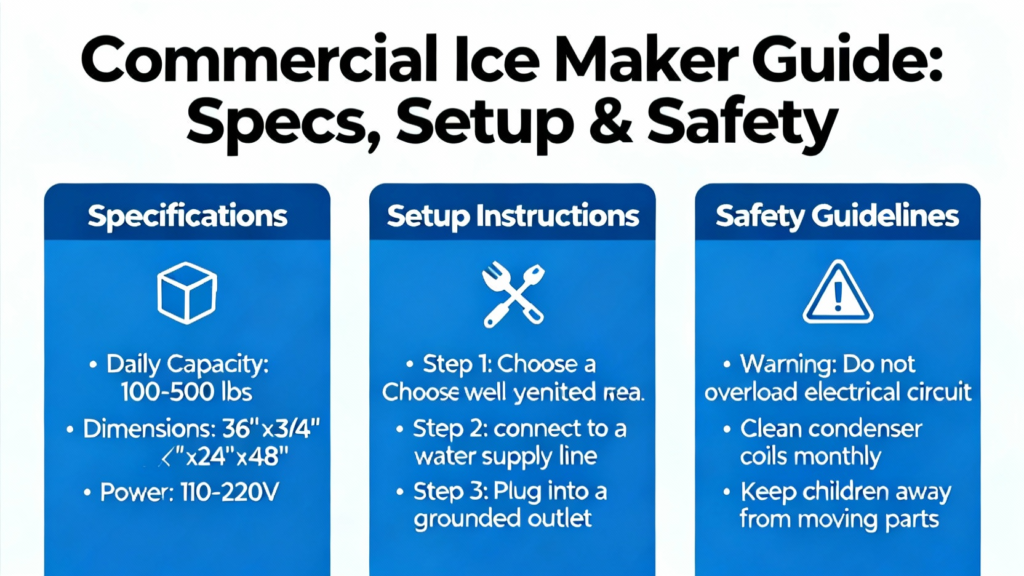
The Ultimate Guide to Heavy-Duty Commercial Ice Makers: Specs, Setup & Safety
Selecting the right commercial ice maker is crucial for hospitality operations. This guide delves into the specifications, proper installation, and critical safety protocols for a durable, stainless steel unit designed for demanding environments like restaurants, bars, and hotels, ensuring you maximize performance and longevity.
Engineering for Commercial Endurance
At the core of any reliable commercial ice maker is its build and operational design. The highlighted unit features a durable stainless steel construction, which is the industry standard for corrosion resistance and ease of cleaning. It operates on standard 110V/60Hz power, drawing 780W, and utilizes environmentally friendly R290 (propane) refrigerant. R290 has gained prominence as a sustainable choice with low global warming potential, a fact noted in discussions on refrigerant trends. Its compatibility with climate types SN, N, and ST means it’s engineered to perform reliably in varied ambient temperatures, from subtropical to temperate zones. With a substantial net weight of ~145.5 lbs and dimensions of 26.4″ x 23.2″ x 61.4″, this commercial ice maker is built for stationary, high-output use in bustling foodservice environments.
Critical Installation and Setup Protocols
Proper installation is non-negotiable for performance and safety. First, the unit requires a potable water line connection with specific pressure between 14.5-58 PSI; outside this range, a pressure changeover valve is mandatory to prevent mechanical issues. Ventilation is key: a minimum 5.9 inches of clearance on all sides is required for airflow and heat dissipation, a point often emphasized by technicians on forums like r/KitchenConfidential. The unit must be placed away from heat sources and direct sunlight. Upon delivery, a crucial step is to let the unit stand upright for 24 hours before initial use, allowing the compressor oil to settle after transport—a common manufacturer directive to prevent premature failure.
Operational Safety and Best Practices
Adhering to safety guidelines protects your investment and premises. The ice maker comes with a three-prong plug and a 70-inch cord; using an extension cord is strongly discouraged as it can overheat and pose a fire risk, a safety warning echoed in appliance manuals and discussions. The unit must be kept away from flammable materials. Furthermore, it is designed for indoor use only; outdoor operation can expose electrical components to moisture and temperature extremes. Internally, only water should be used to make ice. A critical setup step is connecting the gravity drain pipe, as meltwater from the internal tank must be efficiently discharged, with the outlet positioned lower than the machine’s drain port.
Maximizing Performance and Longevity
To ensure consistent ice production and machine health, ongoing considerations are essential. The surrounding environmental temperature directly influences ice-making cycle times; hotter ambient air will reduce efficiency. Regular cleaning and descaling, as per the manual, are vital to prevent mineral buildup, a common cause of breakdowns. The use of a water filter is highly recommended to extend the machine’s lifespan. It’s also important to understand that the unit’s Safety Protection Type I classification indicates it is designed for environments where basic insulation against electric shock is sufficient, meaning it relies on grounded installation. For high-volume needs, exploring a model like the high-capacity stainless steel ice maker ensures you match output to demand.
Conclusion
Investing in a heavy-duty commercial ice maker is a significant decision that impacts daily operations. This analysis underscores that beyond the robust stainless steel frame and efficient R290 refrigerant system, success hinges on meticulous attention to installation details—from water pressure and ventilation space to the mandatory 24-hour settling period. Rigorous adherence to safety protocols, such as avoiding extension cords and ensuring proper drainage, mitigates risk and prevents costly downtime. As highlighted in resources like Wikipedia’s entry on commercial refrigeration, proper setup and maintenance are as critical as the hardware itself. Ultimately, a model built to SN, N, ST climate standards offers versatile reliability. By following these comprehensive guidelines for setup, safety, and operation, businesses can ensure their commercial ice machine delivers peak performance, supporting seamless service in restaurants, bars, and hotels for years to come.
This guide really clarifies the key specs and safety steps for choosing a durable commercial ice maker.
\}}
This guide really clarifies the key specs and safety steps for choosing a durable commercial ice maker.
\}}
This guide really clarifies the key specs and safety steps for choosing a durable commercial ice maker.
\}}
This guide really clarifies the key specs and safety steps for choosing a durable commercial ice maker.
\}}
This guide really clarifies the key specs and safety steps for choosing a durable commercial ice maker.
\}}
This guide really breaks down the specs and safety setup you need to know when choosing a commercial ice maker.
\}}
This guide really breaks down the specs and safety setup you need to know when choosing a commercial ice maker.
\}}
This guide really breaks down the specs and safety setup you need to know when choosing a commercial ice maker.
\}}
This guide really breaks down the specs and safety setup you need to know when choosing a commercial ice maker.
\}}
This guide really helped me understand the specs and safety setup for choosing the right commercial ice maker for our restaurant.
\}}
This guide really helped me understand the specs and safety setup for choosing the right commercial ice maker for our restaurant.
\}}
This guide really helped me understand the specs and safety setup for choosing the right commercial ice maker for our restaurant.
\}}