
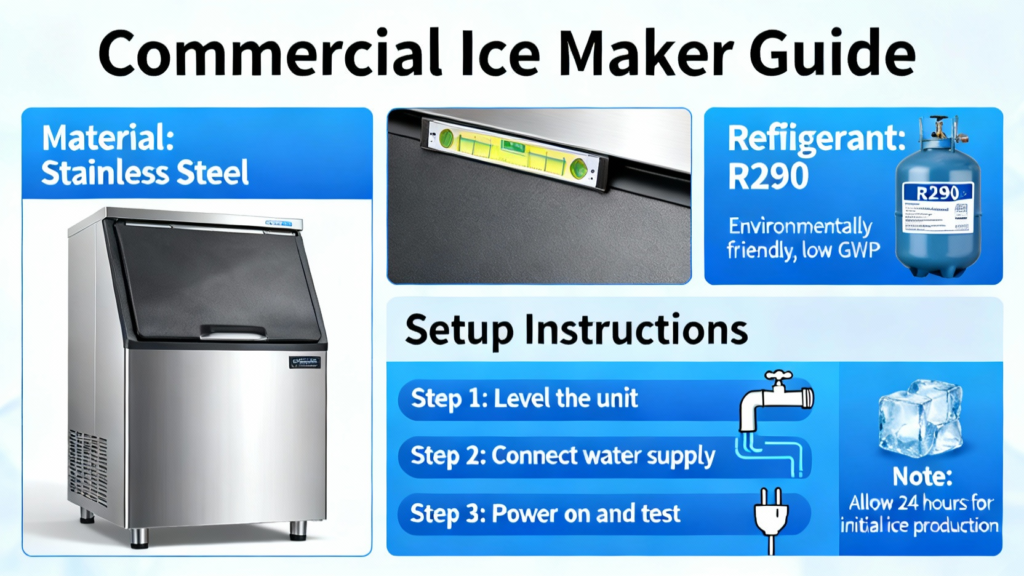
For restaurants, bars, and hotels, a reliable ice maker is the backbone of service. This guide delves into the heavy-duty commercial ice maker, focusing on its durable stainless steel construction, efficient operation, and critical installation requirements. Understanding these elements is key to maximizing performance, ensuring safety, and achieving a strong return on investment for your business.
Engineering for Endurance and Efficiency
At the core of this unit is its durable stainless steel construction, a material chosen for its resistance to corrosion, ease of cleaning, and ability to withstand the rigors of a commercial kitchen. This aligns with industry standards where stainless steel is preferred for food contact surfaces due to its non-porous nature and durability, as noted in discussions on food service equipment longevity. The machine utilizes environmentally friendly R290 (propane) refrigerant, a hydrocarbon with a low Global Warming Potential (GWP). According to Wikipedia, R290 is gaining traction as a sustainable alternative to traditional HFCs, though it requires careful handling due to its flammability. Its compatibility with climate types SN, N, ST ensures reliable ice production across a wide range of ambient temperatures, a critical feature for operations in varied environments.
Powering this efficiency is a 780W, 110V 60Hz system designed for standard commercial kitchen outlets. This specification emphasizes the importance of proper electrical setup to avoid overloading circuits, a common point of discussion among restaurant owners on forums like r/KitchenConfidential. The unit’s substantial net weight of approximately 145.51 lb and dimensions of 26.4 × 23.2 × 61.4 in necessitate planning for placement and underscore its industrial build quality, designed for high-volume output like the 23.23 in. 750 lbs./24h Capacity Commercial Stainless Steel Ice Maker.
Critical Installation and Setup Protocols
Proper installation is non-negotiable for safety and performance. The machine requires a drinking water supply connected to a line with precise water pressure between 14.5-58 psi. Pressure outside this range can damage the unit or hinder ice production, necessitating a pressure changeover valve. Equally vital is the gravity-fed drain pipe connection, which must be installed before operation with its outlet lower than the machine’s to prevent water accumulation and bacterial growth—a frequent topic in health code discussions on Reddit.
Upon delivery, a crucial 24-hour upright settling period is required to let the refrigerant and oils stabilize after transit, preventing compressor damage. The location must provide at least 5.9 inches of clearance on all sides for adequate airflow and heat dissipation, and be kept away from direct sunlight, stoves, or radiators. These steps, often overlooked, are foundational to the unit’s lifespan and efficiency.
Operational Safety and Best Practices
Adhering to safety guidelines protects both personnel and equipment. The unit comes with a three-prong plug and a 70″ power cord, and using an extension cord is strongly discouraged as it may overheat and pose a fire risk, a warning echoed in numerous appliance safety threads. The ice maker must be kept away from flammable materials and is not recommended for outdoor use, as environmental elements can compromise its electrical components and insulation.
Operationally, only potable water should be used to make ice; other liquids can damage the system and contaminate ice. Users should also understand that the surrounding environmental temperature influences ice-making time, with longer cycles in hotter conditions. Regular maintenance, including cleaning and ensuring the wastewater is discharged properly through the drainage port, is essential for consistent hygiene and performance, much like the care required for any high-capacity commercial stainless steel ice maker.
Conclusion: Investing in Reliable Ice Production
Selecting and implementing a heavy-duty commercial ice maker is a significant operational decision. This analysis has highlighted that its value extends beyond the robust stainless steel construction and the efficient, eco-conscious R290 refrigerant system. True reliability is achieved through meticulous attention to the installation prerequisites—from water pressure and drainage to electrical safety and proper settling time. The operational guidelines, such as using only water and maintaining clearances, are not mere suggestions but essential practices that prevent downtime and safety hazards, topics frequently validated by industry professionals in online communities.
Ultimately, a machine like this, comparable to the 750 lbs./24h Capacity Commercial Stainless Steel Ice Maker, is an investment in the seamless flow of your business. By understanding and respecting its engineering requirements and safety protocols, you secure a dependable source of ice that supports service speed, product quality, and customer satisfaction. The upfront effort in correct setup and ongoing adherence to best practices ensures this key piece of equipment delivers its promised performance and durability day in and day out.
This guide really highlights why stainless steel construction is so crucial for a reliable commercial ice maker in a busy setting.
\}}
This guide really highlights why stainless steel construction is so crucial for a reliable commercial ice maker in a busy setting.
\}}
This guide really highlights why stainless steel construction is so crucial for a reliable commercial ice maker in a busy setting.
\}}
Great guide—the emphasis on proper setup for those R290 units is crucial for safety and efficiency.
\}}
Great guide—the emphasis on proper setup for those R290 units is crucial for safety and efficiency.
\}}
Great guide—the emphasis on proper setup for those R290 units is crucial for safety and efficiency.
\}}
Great guide on the importance of a reliable **commercial ice maker** for keeping service running smoothly.
\}}
Great guide on the importance of a reliable **commercial ice maker** for keeping service running smoothly.
\}}
Great guide on the importance of a reliable **commercial ice maker** for keeping service running smoothly.
\}}