
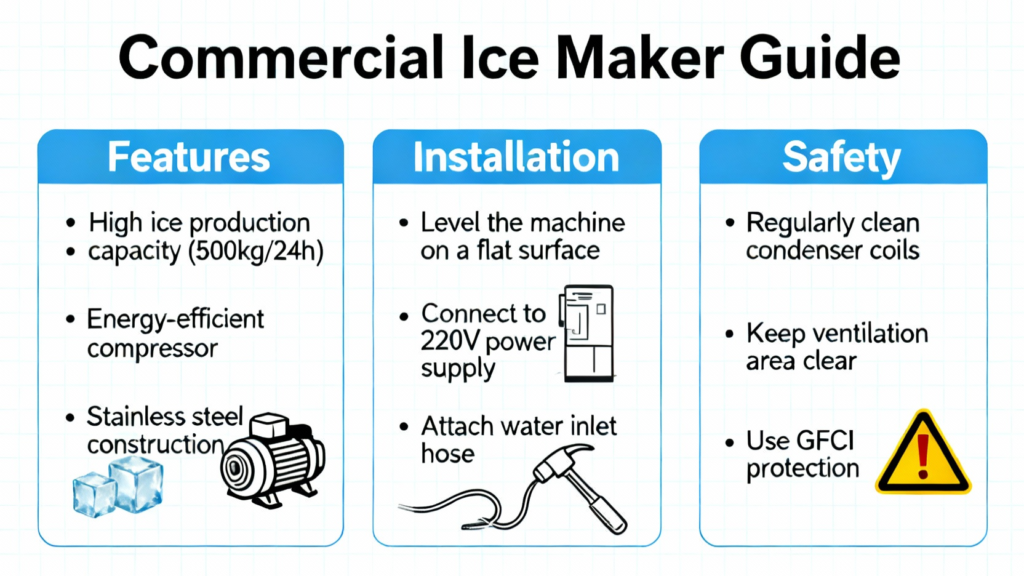
For restaurants, bars, and hotels, a reliable ice maker is the backbone of service. This guide explores the key features, essential installation requirements, and critical safety protocols for operating a heavy-duty, stainless steel commercial ice maker. Understanding these elements is crucial for maximizing performance, ensuring longevity, and maintaining a safe environment in your high-demand business.
Engineering for Commercial Endurance
Built for the rigors of daily service, a commercial ice maker like the 23.2 in. 500 lbs./24h Capacity Commercial Stainless Steel Ice Maker prioritizes durability and consistent output. The stainless steel construction is not just for aesthetics; it resists corrosion, withstands frequent cleaning with harsh chemicals, and maintains hygiene—a critical factor in food service. The use of R290 (propane) refrigerant is a significant modern feature. As noted on Wikipedia, R290 has a “negligible ozone depletion potential and very low global warming potential,” making it an environmentally progressive choice, though it requires proper handling due to its flammability. This unit’s compatibility with multiple climate types (SN, N, ST) ensures it can maintain specified ice production across a range of ambient temperatures, a point often debated by business owners in various climates on forums like r/KitchenConfidential.
Pre-Installation: Space, Power, and Water Essentials
Proper setup is non-negotiable for performance and safety. First, space allocation is critical. The requirement for at least 6 inches of clearance on all sides isn’t arbitrary; it ensures adequate airflow for the condenser to expel heat. Insufficient clearance forces the unit to work harder, increasing energy consumption and potentially causing premature failure. Second, electrical requirements must be respected. The 110V/60Hz/780W specification means it’s designed for standard North American outlets, but the warning against extension cords is serious. As discussed in safety threads on r/Appliances, using an undersized extension cord can cause voltage drop and overheating, creating a fire hazard. Finally, a potable water line with correct pressure (14.5-58 PSI) must be connected. Water pressure outside this range can damage internal valves or slow ice production, necessitating a pressure regulator.
Critical Safety and Initial Startup Protocol
Overlooking safety notes can lead to equipment damage or hazardous situations. Key mandates include keeping the unit away from flammable materials and never using it outdoors, as weather exposure can damage electrical components and void safety certifications. The most crucial step is the 24-hour settling period after delivery. If the unit was tilted during transport, refrigerant oil can migrate into the compressor lines. Starting it immediately can cause catastrophic compressor failure, a costly mistake highlighted in repair discussions online. Furthermore, the gravity drain must be installed correctly, with its outlet lower than the machine’s, to prevent wastewater backflow that can contaminate the ice supply and cause microbial growth.
Optimizing Long-Term Performance and Output
To ensure your commercial ice maker delivers its promised 500 lbs. per day, ongoing environmental management is key. Placement away from direct sunlight and heat sources like stoves is essential, as ambient temperature directly influences freeze cycles. As corroborated by user experiences on Reddit, a cooler environment leads to faster ice production and lower energy use. Regular cleaning and sanitizing with approved solutions—never other liquids—prevents scale and slime mold buildup, which can clog water distribution systems and affect ice clarity and taste. Understanding that ice production time varies with room temperature and humidity allows for better inventory planning during peak business hours.
In conclusion, operating a heavy-duty commercial ice maker successfully hinges on respecting its engineered specifications and operational guidelines. From its durable stainless steel build and eco-friendly R290 refrigerant to the non-negotiable installation requirements of proper clearance, dedicated water line, and correct drainage, each factor plays a vital role. The stringent safety protocols, especially the 24-hour settling period and prohibition on extension cords, are in place to protect both your investment and your premises. By following these detailed steps—sourcing clean water, ensuring adequate ventilation, and maintaining an optimal environment—you transform this powerful appliance into a reliable asset. Ultimately, this diligence guarantees the consistent, high-volume ice production that businesses like restaurants, bars, and hotels depend on to serve customers efficiently and safely, day in and day out.
Great guide—knowing the proper safety protocols for a commercial ice maker is just as important as picking the right features.
\}}
Great guide—knowing the proper safety protocols for a commercial ice maker is just as important as picking the right features.
\}}
Great guide—knowing the proper safety protocols for a commercial ice maker is just as important as picking the right features.
\}}
Great guide—knowing the proper safety protocols for a commercial ice maker is just as important as picking the right features.
\}}
Great guide—knowing the proper safety protocols for a commercial ice maker is just as important as picking the right features.
\}}
This guide really highlights how crucial a reliable ice maker is for smooth daily operations in the hospitality industry.
\}}
This guide really highlights how crucial a reliable ice maker is for smooth daily operations in the hospitality industry.
\}}
This guide really highlights how crucial a reliable ice maker is for smooth daily operations in the hospitality industry.
\}}
This guide really highlights how crucial a reliable ice maker is for smooth daily operations in the hospitality industry.
\}}
This guide really highlights how crucial a reliable ice maker is for smooth daily operations in the hospitality industry.
\}}
This guide is a great reminder that understanding the installation and safety protocols is just as important as the features when choosing a commercial ice maker.
\}}