
The Ultimate Guide to Heavy-Duty Commercial Ice Makers: Specs, Setup & Safety
Selecting the right commercial ice maker is crucial for any foodservice operation. This guide delves into the specifications, proper installation, and critical safety protocols for a durable, stainless steel unit designed for high-demand environments like restaurants, bars, and hotels, ensuring you maximize your investment.
Engineering for Endurance and Efficiency
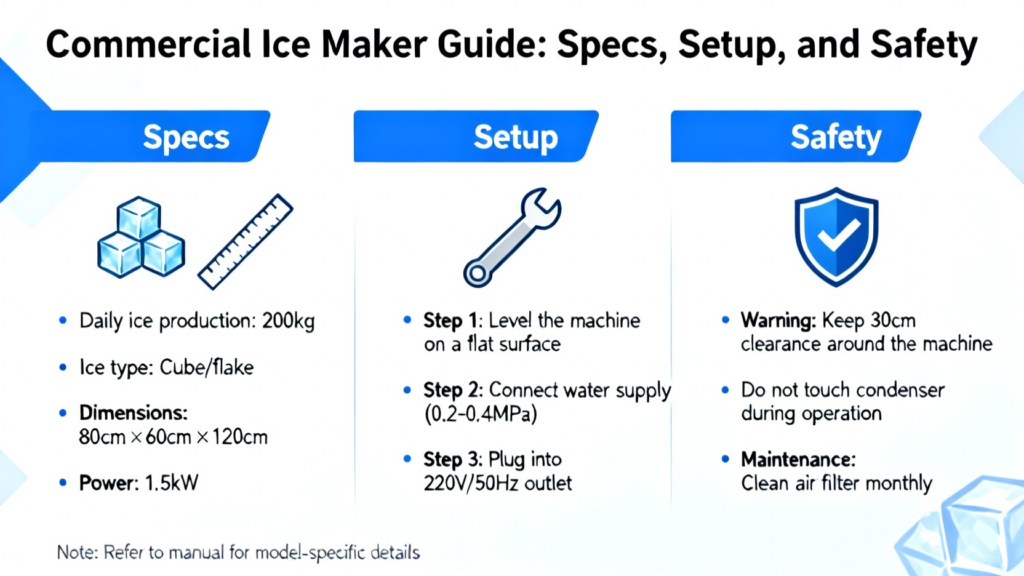
At the core of a reliable commercial ice maker is its construction and operational design. The unit in question features a durable stainless steel exterior, which is the industry standard for corrosion resistance and ease of cleaning. It operates on standard 110V/60Hz power, drawing 780W, and utilizes environmentally friendly R290 (propane) refrigerant. R290 is gaining prominence as a sustainable choice due to its low Global Warming Potential (GWP), a fact noted in discussions on refrigerant trends. Its compatibility with climate types SN, N, and ST (Subnormal, Normal, and Subtropical) means it can maintain reliable performance in a wide range of ambient temperatures, a critical factor for kitchens with variable conditions.
With a substantial net weight of ~145 lbs and dimensions of 26.4″ x 23.2″ x 61.4″, this is a permanent fixture machine built for high-volume output. For operations seeking this blend of durability and modern efficiency, exploring a heavy-duty commercial ice maker with similar specs is a logical step.
Critical Installation and Setup Protocols
Proper installation is non-negotiable for performance and longevity. This involves more than just plugging it in. First, the unit requires a direct connection to a potable water line with a specific pressure range (14.5-58 PSI). Outside this range, a pressure changeover valve is mandatory to prevent mechanical issues. Furthermore, the ice maker must have a functional gravity drain connection installed before operation to handle continuous wastewater discharge from the melting ice in the storage bin.
A key, often overlooked step is the 24-hour settling period after delivery. As emphasized in user manuals and service forums, allowing the unit to stand upright lets the compressor oil settle, preventing premature failure. This is a critical protocol backed by technician advice across appliance repair subreddits, where skipping this step is a common cause of early service calls.
Operational Safety and Environmental Requirements
Commercial equipment demands respect for electrical and fire safety. This ice maker comes with a three-prong plug and a 70-inch cord; using an extension cord is strongly discouraged as it can overheat and pose a fire risk, a warning consistently echoed by safety authorities. The unit must be kept away from flammable materials and heat sources like stoves or direct sunlight, which can force the compressor to overwork.
It is designed for indoor use only. Operating it outdoors exposes electrical components to moisture and temperature extremes beyond its design limits. Additionally, only clean, potable water should be used. Introducing other liquids can damage the water system, alter ice quality, and void the warranty. Ensuring at least 6 inches of clearance on all sides, as specified, is vital for proper airflow and heat dissipation, which directly impacts commercial stainless steel ice maker efficiency and compressor lifespan.
Maximizing Performance and Ice Production
Understanding the factors that influence output ensures you meet your business’s ice demand. The surrounding ambient temperature directly affects ice-making cycle times. In hotter environments, the unit works harder to reject heat, potentially slowing production. This is a fundamental principle of thermodynamics, as the system’s efficiency is tied to the temperature differential it must create.
Regular maintenance, inferred from the need for proper drainage and clearance, is essential. A clogged drain or dusty condenser coil can severely hamper performance. The machine’s gravity-based drainage system is simple but requires the outlet to be lower than the machine’s port to function correctly. For businesses evaluating their ice production needs, considering the full capacity and environmental specs of a high-capacity unit like this stainless steel ice maker is a key part of operational planning.
Conclusion
Investing in a heavy-duty commercial ice maker is a significant decision that impacts daily operations. This analysis has highlighted that beyond the robust stainless steel construction and efficient R290 refrigerant system, success hinges on meticulous attention to installation and safety details. From ensuring correct water pressure and mandatory drainage to adhering to the critical 24-hour settling period and strict indoor-use guidelines, each step is foundational. The operational caveats—avoiding extension cords, maintaining clearance, and understanding ambient temperature effects—are not mere suggestions but essential practices for reliability and safety, as often stressed by industry professionals and technical communities online.
Ultimately, a machine of this caliber is engineered for relentless service in restaurants, bars, hotels, and catering. By following the comprehensive setup protocols and respecting its operational parameters, you secure a reliable ice supply that supports seamless service. Proper care transforms this piece of commercial equipment from a simple appliance into a dependable backbone of your beverage and food service, ensuring it delivers peak performance throughout its service life.
This guide really highlights why paying attention to those **commercial ice maker** specs and safety steps is so important for a smooth operation.
\}}
This guide really highlights why paying attention to those **commercial ice maker** specs and safety steps is so important for a smooth operation.
\}}
This guide really highlights why paying attention to those **commercial ice maker** specs and safety steps is so important for a smooth operation.
\}}
This guide really highlights why paying attention to those **commercial ice maker** specs and safety steps is so important for a smooth operation.
\}}
This guide really highlights why paying attention to those **commercial ice maker** specs and safety steps is so important for a smooth operation.
\}}
This guide really helped me understand the key specs and safety steps for choosing a durable commercial ice maker.
\}}
This guide really helped me understand the key specs and safety steps for choosing a durable commercial ice maker.
\}}
This guide really helped me understand the key specs and safety steps for choosing a durable commercial ice maker.
\}}