
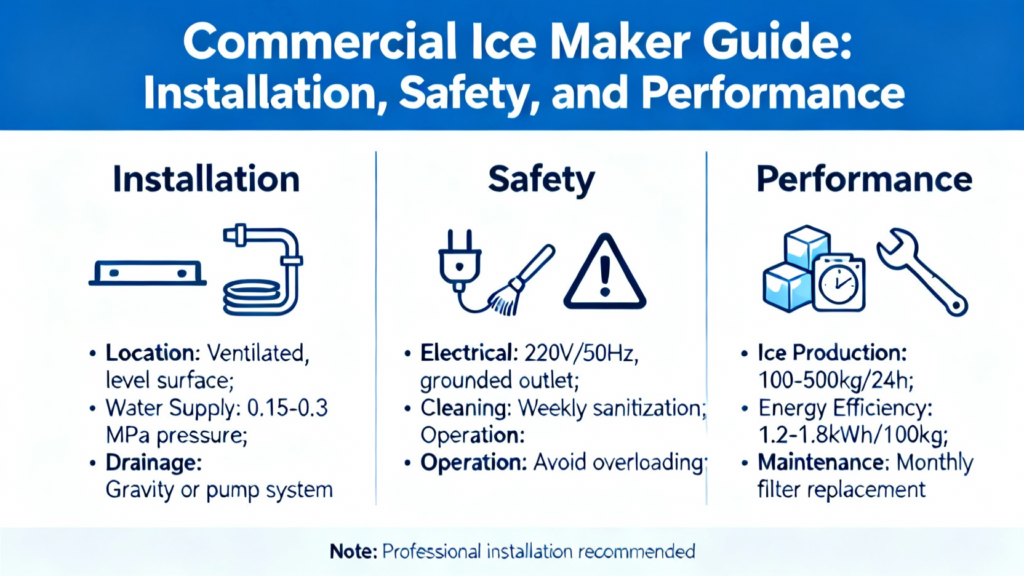
For restaurants, bars, and hotels, a reliable ice supply is non-negotiable. This guide delves into the essential features, proper installation, and critical safety protocols for operating a heavy-duty commercial ice maker. Understanding these elements is key to maximizing the performance and lifespan of your equipment, ensuring you meet customer demand without interruption.
Engineering for Endurance: Core Features of Commercial Ice Makers
High-volume food service operations require equipment built to last. A prime example is a unit like the commercial stainless steel ice maker, which utilizes durable 304-grade stainless steel for corrosion resistance and easy sanitation. The use of environmentally friendly R290 (propane) refrigerant is a significant modern advancement, as it has a lower global warming potential than traditional hydrofluorocarbons (HFCs), a fact noted in discussions on refrigerant phases. Furthermore, compatibility with multiple climate types (SN, N, ST) ensures stable performance whether in a consistently cool storage area or a warmer kitchen environment, addressing a common concern for businesses in varied geographic locations.
Installation Imperatives: Space, Plumbing, and Power
Proper installation is the foundation of reliable operation. Critical requirements include connecting to a potable water line with specific pressure (14.5-58 psi) and ensuring a gravity-fed drain line is positioned lower than the machine’s outlet. Adequate ventilation is mandatory; maintaining at least 6 inches of clearance on all sides prevents overheating and compressor failure. Electrical safety is paramount: these units require a dedicated 110V/60Hz outlet and their included three-prong plug should never be used with an extension cord, as this can lead to overheating—a frequent point of caution in commercial kitchen forums. After delivery, allowing the unit to settle upright for 24 hours before initial use lets the refrigerant and oils stabilize, preventing immediate compressor damage.
Operational Safety and Best Practices
Safe operation protects both your staff and your investment. The machine must be kept away from flammable materials and heat sources like direct sunlight or stoves, as excessive ambient heat will drastically reduce ice production efficiency. It is designed for indoor use only, as outdoor conditions can compromise electrical components and refrigeration cycles. Only clean, potable water should be used; introducing other liquids can damage the internal water system and create unsanitary ice. Regular cleaning and descaling, as per the manufacturer’s schedule, are non-negotiable for food safety and machine longevity, a practice heavily emphasized by health inspectors and veteran chefs alike on hospitality subreddits.
Maximizing Performance and Longevity
To get the most from your heavy-duty ice maker, understand the factors you can control. Ice production time is directly influenced by the surrounding air temperature; a cooler installation space yields faster cycles. Recognize that ice in the storage bin will naturally melt, so the drain must always be functional to handle wastewater. Finally, treat the unit as the professional tool it is. Avoid overloading, perform routine maintenance, and address minor issues promptly. As many equipment repair specialists note, proactive care is far less costly than emergency compressor replacements, ensuring your stainless steel ice maker remains a dependable asset for years.
In summary, a commercial ice maker is a significant investment that demands informed handling from installation through daily operation. Its durable stainless steel construction and modern R290 refrigerant system are engineered for high-volume, sustainable output, but only when paired with correct setup—including proper water pressure, drainage, and electrical connection. Adherence to safety protocols, such as avoiding extension cords and flammable materials, is critical to prevent hazards. Ultimately, the machine’s performance and lifespan are heavily dependent on the operator’s understanding of its needs: a suitable environment, regular maintenance, and respect for its operational limits. By integrating these technical specifications and best practices into your kitchen’s routine, you transform a piece of equipment into a reliable cornerstone of your service, ensuring a constant supply of ice to meet the demands of your clientele and uphold your establishment’s reputation.
This guide is a great reminder that proper installation and safety are just as important as the features when you’re choosing a commercial ice maker.
\}}
This guide is a great reminder that proper installation and safety are just as important as the features when you’re choosing a commercial ice maker.
\}}
This guide is a great reminder that proper installation and safety are just as important as the features when you’re choosing a commercial ice maker.
\}}
This guide is a great reminder that proper installation and safety are just as important as the features when you’re choosing a commercial ice maker.
\}}
This guide is a great reminder that proper installation and safety are just as important as the features when you’re choosing a commercial ice maker.
\}}
This guide is a must-read for anyone installing a commercial ice maker, as proper setup is crucial for safety and performance.
\}}
This guide is a must-read for anyone installing a commercial ice maker, as proper setup is crucial for safety and performance.
\}}
This guide is a must-read for anyone installing a commercial ice maker, as proper setup is crucial for safety and performance.
\}}
This guide is a must-read for anyone installing a commercial ice maker, as proper setup is crucial for safety and performance.
\}}
This guide is a must-read for anyone installing a commercial ice maker, as getting those safety protocols right from the start is so important.
\}}
This guide is a must-read for anyone installing a commercial ice maker, as getting those safety protocols right from the start is so important.
\}}
This guide is a must-read for anyone installing a commercial ice maker, as getting those safety protocols right from the start is so important.
\}}
This guide is a must-read for anyone installing a commercial ice maker, as getting those safety protocols right from the start is so important.
\}}