
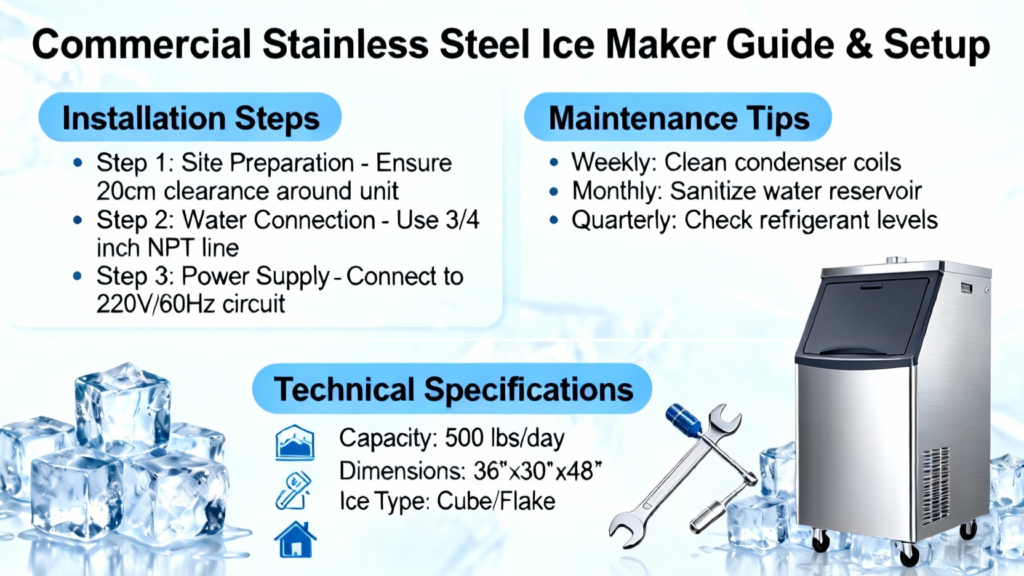
For any high-volume food service operation, a reliable ice maker is the unsung hero of the kitchen. This guide delves into the critical specifications and essential installation requirements of a heavy-duty commercial ice maker built with durable stainless steel. We’ll explore its operational features, from climate compatibility to safety, and provide a detailed roadmap for proper setup to ensure optimal performance and longevity for your business.
Engineering for Endurance: Core Specifications and Build
At its heart, this commercial ice maker is engineered for relentless use. The durable stainless steel construction is not just for aesthetics; it provides superior corrosion resistance, ease of sanitation, and structural integrity, which is critical in damp, high-use environments. With a net weight of approximately 145.51 lb and dimensions of 26.4 × 23.2 × 61.4 in, it’s a substantial piece of equipment designed for stationary, high-output service. Its compatibility with climate types SN, N, and ST (Subnormal, Normal, and Subtropical) ensures reliable performance across a wide range of ambient temperatures, a feature backed by standardized industry testing protocols for refrigeration equipment. This broad compatibility makes it a versatile choice for various geographical locations and kitchen environments.
Power, Refrigerant, and Operational Safety
Operating on standard 110V/60Hz power with a 780W draw, this unit is designed for plug-and-play compatibility in most North American commercial settings. A significant modern feature is its use of environmentally friendly R290 (propane) refrigerant. R290 has a very low Global Warming Potential (GWP) compared to traditional HFCs, aligning with global environmental regulations like the EPA’s SNAP program and the EU’s F-Gas regulation. According to discussions on Reddit, professionals note that while R290 is efficient and eco-friendly, it requires proper handling due to its flammability, underscoring the importance of the unit’s Safety protection type I classification and the manufacturer’s warning to keep the unit away from flammable materials. A user in an r/refrigeration thread from late 2023 highlighted the industry’s shift towards these natural refrigerants for commercial equipment.
Critical Installation and Setup Guidelines
Proper installation is paramount for safety, efficiency, and warranty adherence. The provided notes are not mere suggestions but essential requirements:
- Location & Ventilation: A minimum of 5.9 inches of clearance on all sides is required for airflow. The unit must be kept from direct sunlight, stoves, or radiators, as ambient temperature directly influences ice production time.
- Water and Drainage: It requires a drinking water supply with precise pressure (14.5-58 psi). A gravity-fed drain pipe, with its outlet lower than the machine’s, is mandatory to handle meltwater and discharge, preventing internal flooding.
- Initial Startup: After delivery, the unit must stand upright for 24 hours to let the compressor oil settle. Furthermore, as advised for many refrigeration systems, allowing an hour for the refrigerant to settle before the initial plug-in is crucial for system longevity.
- Electrical Safety: The included 70″ three-prong plug should be used without extension cords to prevent overheating and fire risk. Outdoor use is not recommended.
Optimizing for Long-Term Commercial Use
To maximize the lifespan of your investment, adherence to operational guidelines is key. This includes using only water to make ice, as other liquids can damage the evaporator and contaminate the ice. The note about ice melting in the inner tank highlights the continuous cycle of production and melt, making that drain connection non-negotiable. For operations needing robust output, ensuring the environment is within the specified climate range will guarantee the machine meets its capacity claims. Regular cleaning and maintenance, as one would perform on any critical piece of commercial kitchen equipment documented on resources like Wikipedia’s ice machine page, are essential to prevent scale buildup and sanitary issues.
In conclusion, this heavy-duty commercial ice maker represents a significant investment in the operational flow of a restaurant, bar, hotel, or catering service. Its stainless steel construction and broad climate compatibility promise durability, while its use of R290 refrigerant positions it as a more environmentally conscious choice. However, its technical prowess is entirely dependent on meticulous installation and operation. From the critical 24-hour settling period post-delivery to the precise water pressure requirements and mandatory drainage setup, each step is designed to ensure safety, efficiency, and reliability. By understanding and respecting these specifications—the need for clearance, the prohibition of extension cords, and the optimal environmental conditions—business owners can secure a reliable ice supply that supports seamless service. Ultimately, the performance of a machine like the 23.2 in. 500 lbs./24h Capacity Commercial Stainless Steel Ice Maker is a partnership between its engineered capabilities and the user’s commitment to proper setup and care, ensuring it serves as a dependable asset for years to come.
This guide really highlights why a reliable commercial ice maker is such a kitchen workhorse.
\}}
This guide really highlights why a reliable commercial ice maker is such a kitchen workhorse.
\}}
This guide really highlights why a reliable commercial ice maker is such a kitchen workhorse.
\}}
This guide is a fantastic resource for understanding the essential specs and setup of a durable stainless steel ice maker, the true unsung hero of a busy kitchen.
\}}
This guide is a fantastic resource for understanding the essential specs and setup of a durable stainless steel ice maker, the true unsung hero of a busy kitchen.
\}}
This guide is a fantastic resource for understanding the essential specs and setup of a durable stainless steel ice maker, the true unsung hero of a busy kitchen.
\}}
This guide is a great reminder of why a reliable commercial ice maker is such a crucial piece of equipment for a busy kitchen.
\}}