
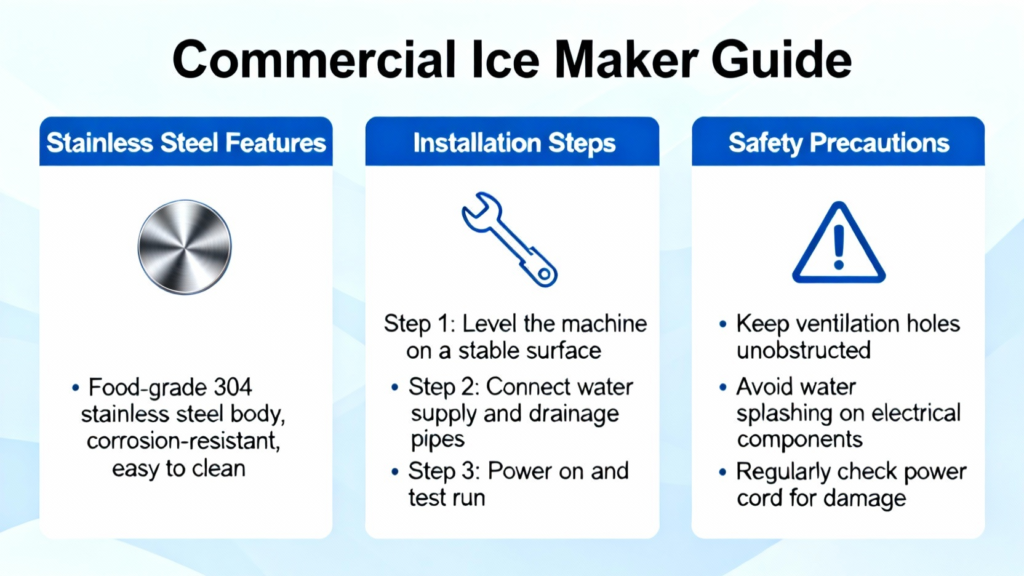
For restaurants, bars, and hotels, a reliable ice maker is a cornerstone of daily operations. This guide delves into the Heavy-Duty Commercial Ice Maker, exploring its robust stainless steel construction, key installation requirements, and essential safety protocols. Understanding these details ensures optimal performance, longevity, and safety for your high-volume ice production needs.
Engineering for Endurance: Stainless Steel and Eco-Conscious Design
At the heart of this unit is its durable stainless steel construction, a material chosen for its exceptional resistance to corrosion, ease of cleaning, and ability to withstand the rigors of a commercial kitchen. This aligns with industry standards where hygiene and durability are paramount. Furthermore, the use of environmentally friendly R290 (propane) refrigerant marks a significant step toward sustainability. R290 has a Global Warming Potential (GWP) of 3, drastically lower than traditional hydrofluorocarbon (HFC) refrigerants, as noted in discussions on refrigerant alternatives on Reddit. Its compatibility with climate types SN, N, and ST ensures reliable ice production in varied ambient temperatures.
Critical Installation and Setup Protocols
Proper installation is non-negotiable for performance and safety. The unit requires a dedicated drinking water supply with precise pressure (14.5-58 psi) and a proper gravity-fed drainage connection. A crucial, often overlooked step is the 24-hour settling period after delivery. This allows the compressor oil, which may have migrated during transit, to settle back, preventing damage upon startup—a point frequently emphasized by professionals in appliance forums. Adequate clearance (at least 5.9 inches on all sides) is also vital for airflow and heat dissipation, directly impacting the ice maker’s efficiency and compressor lifespan.
Essential Safety and Operational Guidelines
Adhering to safety guidelines protects both your staff and your investment. Key rules include:
- Avoiding extension cords: The 780W draw requires a direct outlet connection to prevent overheating and fire risk.
- Keeping away from heat and flammables: The unit should be placed away from stoves, radiators, and direct sunlight.
- Using water only: Introducing other liquids can damage the system and contaminate ice.
- Indoor use only: The machine is not rated for outdoor conditions, which can affect electrical safety and performance.
These precautions are standard for commercial appliances, as their constant operation demands strict adherence to electrical and environmental safety codes.
Optimizing Performance and Long-Term Reliability
To ensure the Commercial Stainless Steel Ice Maker delivers its promised 500 lbs./24h capacity, operators must understand influencing factors. The surrounding environmental temperature significantly affects ice-making cycle times; higher ambient temperatures can reduce output. Regular maintenance, such as cleaning and sanitizing according to the manufacturer’s schedule, is critical to prevent scale buildup and bacterial growth, topics widely covered in food service subreddits like r/KitchenConfidential. The self-contained, gravity-based wastewater disposal system also requires a clear, downward-sloping drain line to function correctly.
In conclusion, integrating a heavy-duty commercial ice maker into your business is a significant investment that goes beyond plugging in an appliance. It requires a thorough understanding of its stainless steel engineering and eco-friendly R290 refrigerant system. Successful deployment hinges on meticulous attention to installation protocols, including water pressure, drainage, and the critical settling period. Strict adherence to safety guidelines—such as avoiding extension cords and ensuring proper ventilation—is essential to mitigate risks. Finally, recognizing that factors like ambient temperature and consistent maintenance impact output is key to achieving the reliable, high-volume ice production that establishments like restaurants and bars depend on. By following these comprehensive steps, you ensure that this powerful piece of equipment, like the 500 lbs./24h capacity model, operates safely, efficiently, and reliably for years to come, supporting the seamless flow of your daily operations.
Great guide—really highlights why stainless steel construction is so crucial for a heavy-duty commercial ice maker’s durability and safety.
\}}
Great guide—really highlights why stainless steel construction is so crucial for a heavy-duty commercial ice maker’s durability and safety.
\}}
Great guide—really highlights why stainless steel construction is so crucial for a heavy-duty commercial ice maker’s durability and safety.
\}}
Great guide—really highlights why stainless steel construction is so crucial for a heavy-duty commercial ice maker’s durability and safety.
\}}
Great guide—really highlights why stainless steel construction is so crucial for a heavy-duty commercial ice maker’s durability and safety.
\}}
This guide really highlights why a heavy-duty commercial ice maker is such a crucial investment for busy operations.
\}}
This guide really highlights why a heavy-duty commercial ice maker is such a crucial investment for busy operations.
\}}
This guide really highlights why a heavy-duty commercial ice maker is such a crucial investment for busy operations.
\}}
Great guide—really highlights why stainless steel construction is so crucial for a commercial ice maker’s durability and safety.
\}}
Great guide—really highlights why stainless steel construction is so crucial for a commercial ice maker’s durability and safety.
\}}
Great guide—really highlights why stainless steel construction is so crucial for a commercial ice maker’s durability and safety.
\}}