
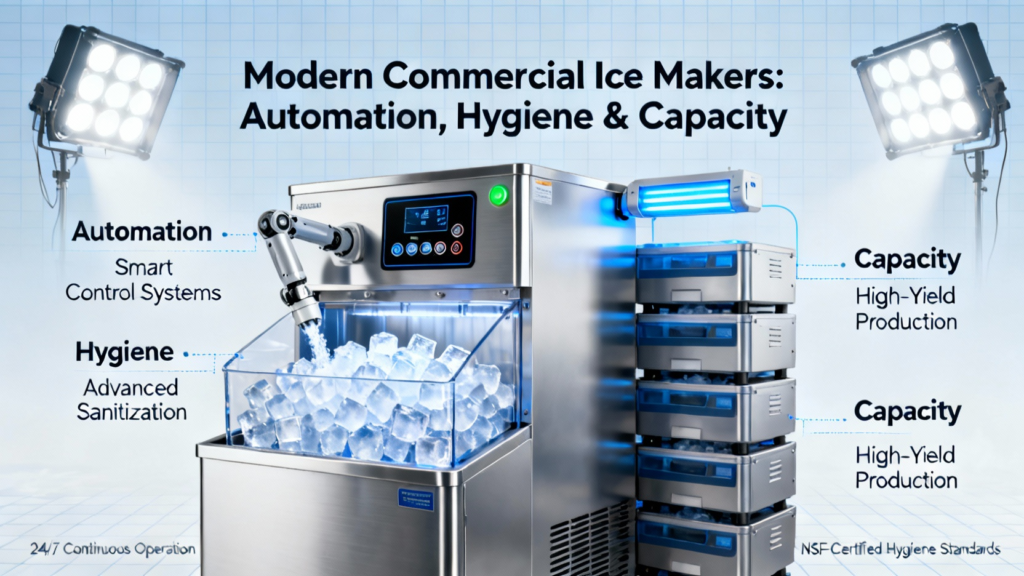
In the demanding world of commercial food service and hospitality, ice production is a critical, non-negotiable operation. This article explores the advanced features of modern commercial ice makers, focusing on how innovations in automation, capacity, and user-centric design converge to ensure reliability, hygiene, and uninterrupted service for high-volume environments.
Intelligent Automation for Uninterrupted Operation
Modern commercial ice makers transcend simple freezing mechanisms; they are intelligent systems designed for operational continuity. Key to this is the integration of proactive fault and alert systems. A water shortage alert prevents damage to the compressor by halting the cycle when supply is low, a common point of failure in lesser units. Similarly, the auto-defrost function eliminates the labor-intensive and often-forgotten manual process, using timed cycles to melt frost buildup, which maintains peak energy efficiency and consistent ice production. As noted in a discussion on r/refrigeration, regular defrosting is crucial to prevent “reduced capacity and higher energy consumption,” making automation a significant upgrade.
Hygiene, Capacity, and Ergonomic Access
Hygiene and volume are paramount in commercial settings. The inclusion of a integrated water filter is essential, removing impurities and minerals to produce clear, clean-tasting ice and protecting the machine’s internal components from scale. This aligns with food safety principles, as contaminant-free ice is a standard health code expectation. For volume, a machine like the Tittla split commercial ice maker addresses this directly with a bin holding 300 lbs. of ice and a daily production exceeding 450 lbs. Ergonomic access, such as a flip-up bin door and dedicated scoop, allows staff to serve ice quickly without contaminating the storage bin, a simple yet critical design feature for busy operations.
Stability, Control, and User Interface
Consistent ice production relies on a stable, level installation. Four adjustable feet compensate for uneven floors, eliminating vibration and ensuring the unit operates as engineered. User control is centralized through an intuitive touch panel, allowing for easy mode selection and system checks. The blue-lighted storage bin serves a dual purpose: providing ambient illumination in low-light kitchen areas and acting as a visual indicator of ice level from a distance. This combination of practical stability and clear user feedback minimizes operational errors and simplifies staff training.
Reliable Drainage and System Design
The final hallmark of a robust commercial ice maker is its handling of water and meltage. A split-system design separates the ice-making engine from the storage bin, allowing for flexible installation and reducing the heat load on the stored ice. Crucially, such systems offer versatile drainage options. The main unit typically employs a water pump drainage for positive removal of wastewater, while the storage bin may use simpler gravity drainage. This ensures that both the production cycle and the natural melting process are managed effectively, preventing overflow and sanitation issues. The importance of proper drainage is well-documented in equipment maintenance guides, as standing water can lead to bacterial growth and component failure.
In conclusion, selecting a commercial ice maker requires looking beyond mere output numbers. As we have explored, the integration of intelligent alerts—for faults, water shortage, and bin capacity—forms a proactive network that safeguards your investment and prevents operational downtime. The critical role of automated defrosting and water filtration cannot be overstated, as they directly impact energy efficiency, ice quality, and compliance with health standards. The substantial capacity and ergonomic access of a unit like the Tittla 450 lbs. per day ice maker meet the tangible demand of high-volume settings, while stability features and intuitive controls ensure seamless daily integration. Ultimately, the advanced drainage solutions and split-system design represent the engineering foresight that defines professional-grade equipment. Investing in a machine that masters these interconnected aspects—automation, hygiene, capacity, and robust design—is not just purchasing an appliance; it is ensuring a reliable, sanitary, and uninterrupted ice supply that forms the backbone of beverage service, food presentation, and customer satisfaction in any demanding commercial establishment.
It’s amazing how much modern automation in these ice makers can boost both hygiene and reliability for busy kitchens.
\}}
It’s amazing how much modern automation in these ice makers can boost both hygiene and reliability for busy kitchens.
\}}
It’s amazing how much modern automation in these ice makers can boost both hygiene and reliability for busy kitchens.
\}}
It’s amazing how much modern automation in these ice makers can boost both hygiene and reliability for busy kitchens.
\}}
It’s amazing how much modern automation in these ice makers can boost both hygiene and reliability for busy kitchens.
\}}
The automation features in modern ice makers you described are a total game-changer for busy kitchens.
\}}
The automation features in modern ice makers you described are a total game-changer for busy kitchens.
\}}
The automation features in modern ice makers you described are a total game-changer for busy kitchens.
\}}
It’s impressive how modern automation in these ice makers can handle such high demand while keeping hygiene a top priority.
\}}
It’s impressive how modern automation in these ice makers can handle such high demand while keeping hygiene a top priority.
\}}
It’s impressive how modern automation in these ice makers can handle such high demand while keeping hygiene a top priority.
\}}
It’s impressive how modern automation in these ice makers can handle such high demand while keeping hygiene a top priority.
\}}