
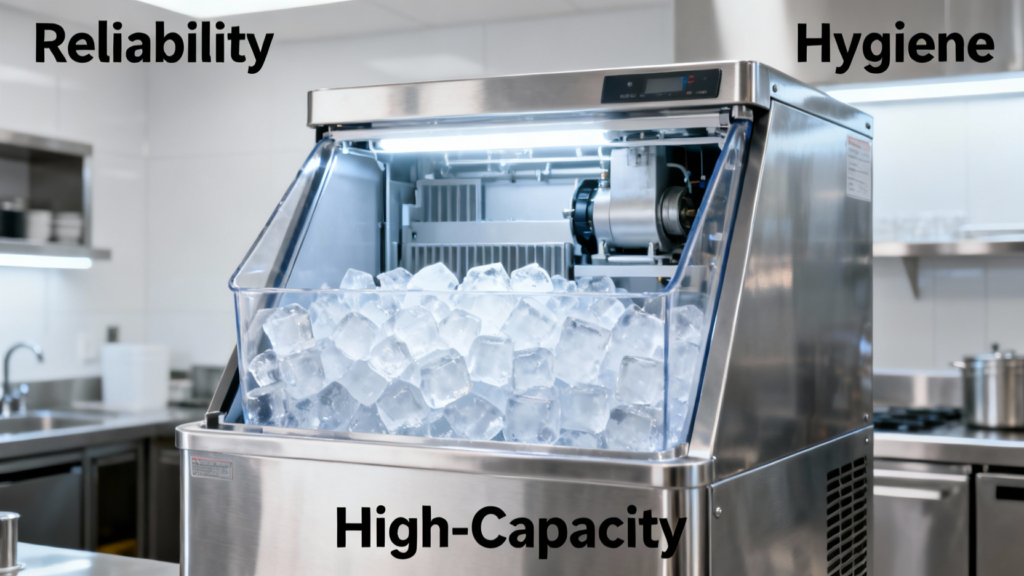
For any business reliant on a steady supply of ice, machine failure is more than an inconvenience—it’s a direct threat to operations and revenue. This article explores the critical features of modern commercial ice makers, focusing on intelligent alerts, automated maintenance, and high-capacity design that work in concert to ensure reliability, hygiene, and uninterrupted service for demanding environments.
Intelligent Operation and Proactive Alerts
Modern commercial ice makers transcend simple production; they are connected appliances designed for operational intelligence. Key to this is a suite of fault and status alerts. A water shortage alert prevents pump damage and production halts by notifying staff to check the supply line, a common point of failure noted in industry discussions. Similarly, a discreet ice full alert stops production automatically to prevent bin overflows that can strain components and create slip hazards. This proactive approach to maintenance, moving from reactive fixes to preventive alerts, is a cornerstone of modern commercial kitchen equipment design, as emphasized in food service equipment forums.
Automated Maintenance for Hygiene and Efficiency
Manual defrosting is a time-consuming and often neglected task that reduces efficiency and ice quality. Auto defrost systems periodically melt away frost buildup on the evaporator, ensuring the unit always runs at peak energy efficiency and production capacity. This, combined with an integrated water filter, is essential for food safety and ice clarity. Filters remove sediments and impurities, directly impacting taste and purity. As noted in food safety guidelines, using filtered water in ice production is as critical as using it in food preparation, preventing contaminants from entering the consumer’s glass.
Engineered for Stability and High-Volume Output
Consistent, high-volume production requires a stable foundation. 4-adjustable feet allow for perfect leveling on uneven floors, eliminating vibrations that can cause premature wear and ensuring even ice production cycles. This stability supports the core function: massive output. A unit like the 22.3″ Commercial Split Ice Maker — 420 lbs/24h is engineered for this demand, producing hundreds of pounds of ice daily. The split design, separating the condenser from the ice-making mechanism, allows for installation in tighter, hotter spaces without sacrificing performance, a design praised in commercial appliance reviews for its versatility in bars and high-volume kitchens.
User-Centric Design and Service Accessibility
The final layer of a superior ice maker focuses on the user experience. An intuitive touch control panel simplifies operation, while features like a blue lighted storage bin and a flip-up door with included scoop enhance both aesthetics and hygienic, easy access. Furthermore, flexible drainage options—water pump drainage for the main unit and gravity drainage for the bin—provide crucial installation adaptability for various kitchen layouts. This focus on serviceability and ease-of-use reduces staff training time and minimizes downtime during cleaning, ensuring the machine integrates seamlessly into daily workflow.
In conclusion, selecting a commercial ice maker today requires looking beyond mere production specs. It demands a machine built with operational intelligence to prevent failures through proactive alerts, automated maintenance features that uphold hygiene and efficiency, and a robust, high-capacity design engineered for stability. As evidenced by discussions in hospitality subreddits and equipment wikis, the most reliable systems combine these elements with user-centric design, offering intuitive controls and flexible installation. A model like the 22.3″ Commercial Split Ice Maker exemplifies this holistic approach. By investing in a unit that masters these four pillars—intelligence, automation, engineering, and design—business owners secure more than an ice source; they gain a dependable partner that safeguards service continuity, reduces labor costs, and ensures every guest receives perfectly clean, clear ice, day after day.
It’s great to see how modern commercial ice makers use intelligent alerts and automated maintenance to prevent those costly operational shutdowns.
\}}
It’s great to see how modern commercial ice makers use intelligent alerts and automated maintenance to prevent those costly operational shutdowns.
\}}
It’s great to see how modern commercial ice makers use intelligent alerts and automated maintenance to prevent those costly operational shutdowns.
\}}
It’s great to see how modern commercial ice makers use intelligent alerts and automated maintenance to prevent those costly operational shutdowns.
\}}
It’s great to see how modern commercial ice makers use intelligent alerts and automated maintenance to prevent those costly operational shutdowns.
\}}
It’s amazing how modern commercial ice makers use intelligent alerts and automated maintenance to prevent those costly operational shutdowns.
\}}
It’s amazing how modern commercial ice makers use intelligent alerts and automated maintenance to prevent those costly operational shutdowns.
\}}
It’s amazing how modern commercial ice makers use intelligent alerts and automated maintenance to prevent those costly operational shutdowns.
\}}
It’s amazing how modern commercial ice makers use intelligent alerts and automated maintenance to prevent those costly operational shutdowns.
\}}
It’s amazing how modern commercial ice makers can prevent costly downtime with those smart alerts and automated maintenance features.
\}}
It’s amazing how modern commercial ice makers can prevent costly downtime with those smart alerts and automated maintenance features.
\}}
It’s amazing how modern commercial ice makers can prevent costly downtime with those smart alerts and automated maintenance features.
\}}